
21 Days in Singapore: The 1987 Footage
From August 8 to 28, 1987, Chen Songru led eight master chefs — six from the Beijing Sichuan Restaurant and two from Xiangshan Hotel — to Singapore to present “Taste of Sichuan: State Banquet of Sichuan Cuisine” over 21 days, causing a sensation in the Lion City. Until now, this site held only five photographs and a single menu page from the event. Now, a videotape sealed away for more than three decades has been digitally restored and released for the first time — moving footage that fills the exact gap the still photographs could not: what he actually did on an international stage, how he taught, and how he spoke on behalf of an entire cuisine. The clip in Unit 07 of him speaking into a microphone — confirmed by his family to be his own voice — is one of only two publicly available recordings in which his own voice can be heard; the other is in a 1991 profile film produced by the restaurant’s Party branch, presented in a separate exhibition on this site.
How Singapore Received Him: What They Said About This Chinese Chef
Evidence legend: First-hand account Autobiography or direct disciple testimony · First-Hand Object Original photograph/certificate preserved by the family · Independent source Third-party media cross-verification · Biographical account Found only in biographical manuscripts · Unverified Conflicting accounts across sources
◈ “China’s National Treasure of Sichuan Cuisine”
The title that would come to accompany Chen Songru’s name was given by the Singaporean press during this very trip in 1987. For a chef who had come out of rural Ziyang, Sichuan, these 21 days marked the first time his skill was framed by international coverage not as “a good chef,” but as the representative figure of an entire national cuisine.Independent source1
Honest Boundaries
“China’s national treasure of Sichuan cuisine” was an honorific given by the local Singaporean press at the time of the 1987 event. Lee Kuan Yew’s in-person visit is corroborated by independent material; his specific remarks are currently found only in the biography manuscript, and this site labels each claim according to its level of evidence, as it does throughout. For more clippings, see the News →
From Beijing to Singapore
In August 1987, 66-year-old Chen Songru led eight master chefs — six from the Beijing Sichuan Restaurant, two from Xiangshan Hotel — from Beijing across roughly 4,500 kilometers to bring “State Banquet of Sichuan Cuisine” to the tables of Singapore’s China Restaurant. It was the single most important international trip of his life.First-hand account3
-
Aug. 4, 1987 · A Prelude
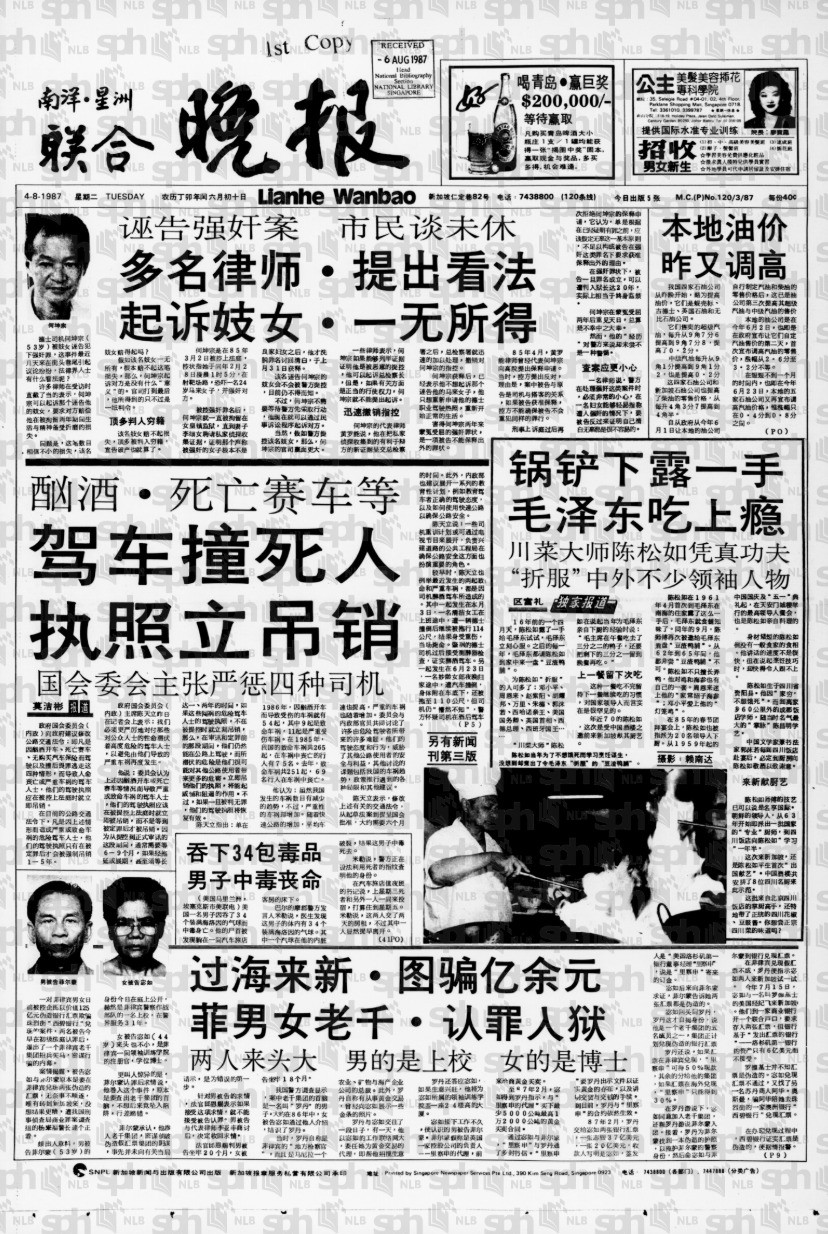
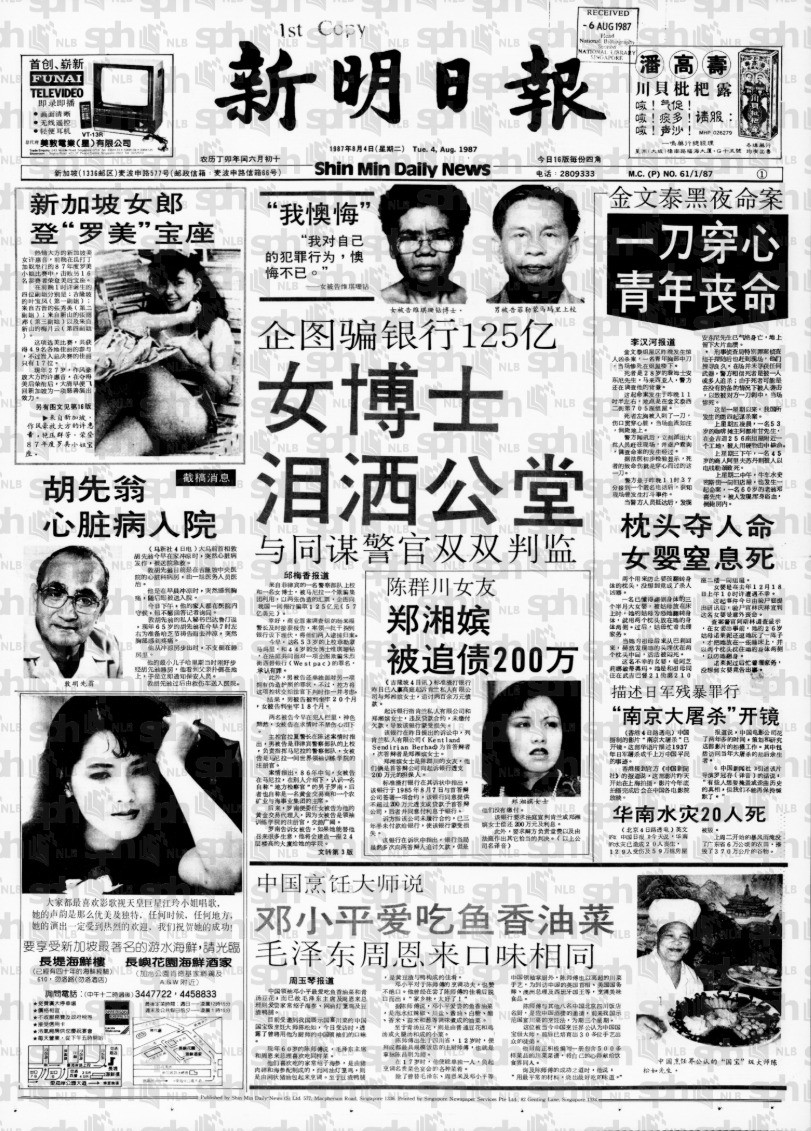
Four days before the opening, Singapore’s Shin Min Daily News and Lianhe Wanbao (南洋·星洲联合晚报) both ran feature interviews the same day, introducing readers in Singapore to the Sichuan master chef who had “cooked for Mao Zedong, Zhou Enlai, and Deng Xiaoping” (the press assessments are in Unit 00).
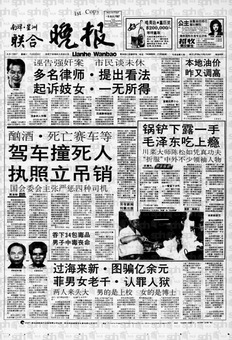 Lianhe Wanbao (Nanyang / Sin Chew), 4 August 1987 — full front page
Original clipping →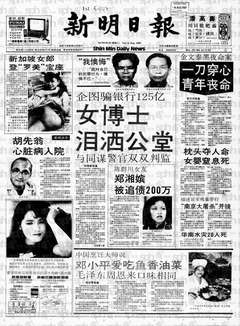 Shin Min Daily News, 4 August 1987 — full front page
Original clipping →Both full front pages come from NewspaperSG →, the newspaper database of the National Library Board, Singapore; copyright remains with the original publishers. The clippings kept by the family are in the Digital Archive →
-
Aug. 5, 1987 · A tasting
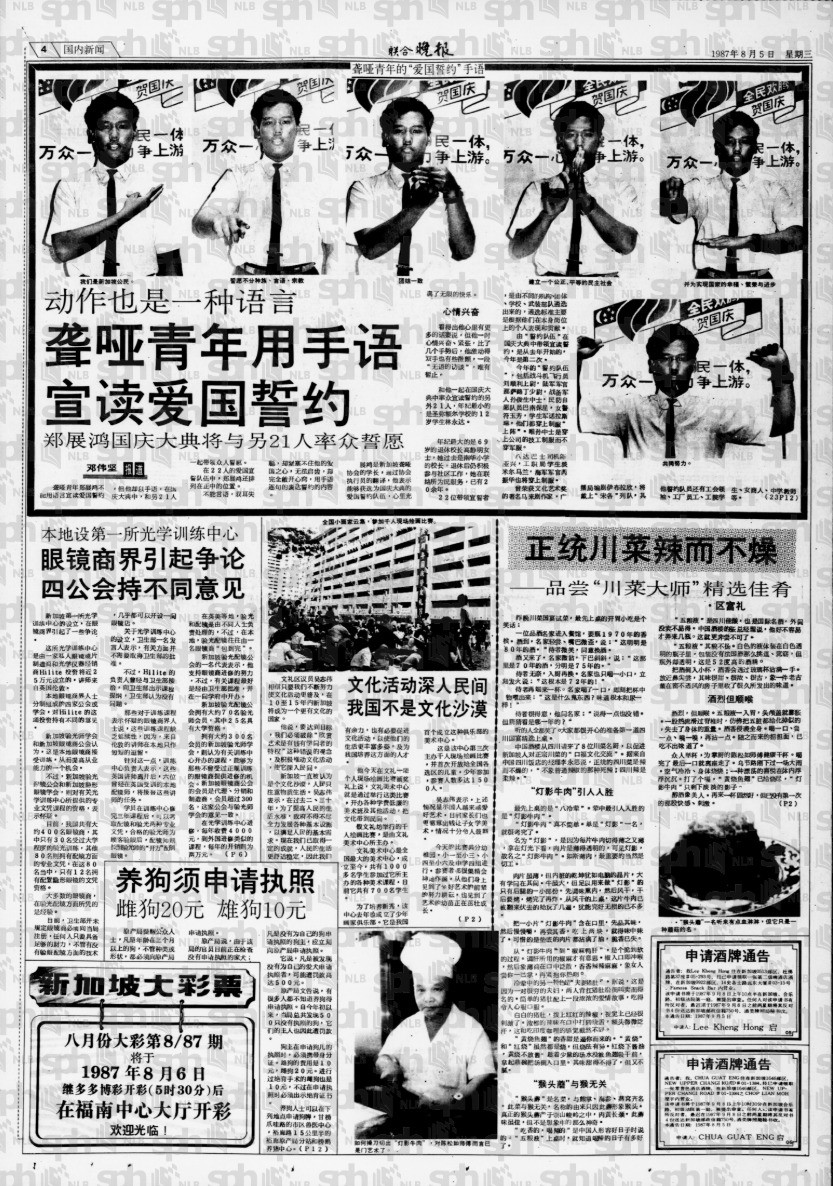
Three days before the opening, Lianhe Wanbao ran a tasting review — “Authentic Sichuan: hot but not parching — sampling the master’s selected dishes” by Au Fu-lai — noting details from the table: the “lantern-shadow beef” among the eight cold dishes, the Wuliangye served alongside.This one carries a different kind of weight from the rest: it is a review written after the meal — not a memorial piece, not a press release. Among everything this site holds, it is the first assessment written at the time, on the spot, by a working journalist.
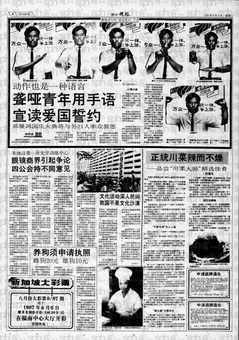 Lianhe Wanbao, 5 August 1987, page 4 — tasting review
Original clipping →The page images come from NewspaperSG →, the newspaper database of the National Library Board, Singapore; copyright remains with the original publishers. The clippings kept by the family are in the Digital Archive →
-
Aug. 8, 1987 · Opening
“Taste of Sichuan: State Banquet of Sichuan Cuisine” opened at Singapore’s China Restaurant. A banner at the venue marked the run of dates “8-8-1987 ~ 28-8-1987,” a joint presentation by Singapore’s China Restaurant, the Beijing Sichuan Restaurant, and Xiangshan Hotel.Primary object4
-
Aug. 8–28 · 21 Days
For a full 21 days, Chen Songru and his team presented state-banquet-level Sichuan cuisine every day — footage, photographs, and menu materials of the venue, kitchen, and ceremonies are woven together by theme in Units 03–07.The Chinese- and English-language press in Singapore kept covering the run; the five pages below are five of those.
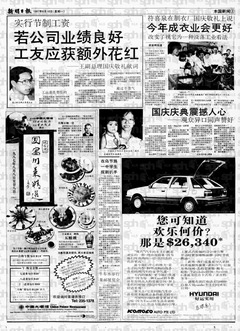 Shin Min Daily News, 10 August 1987, Home News 3
Original clipping →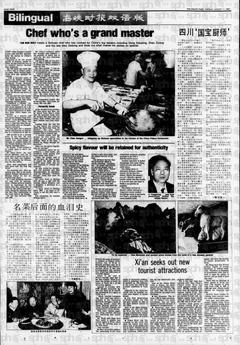 The Straits Times, 11 August 1987, Page Four — bilingual feature
Original clipping →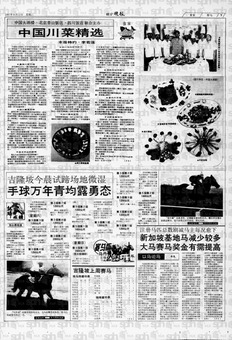 Lianhe Wanbao, 12 August 1987, page 7 — Food
Original clipping →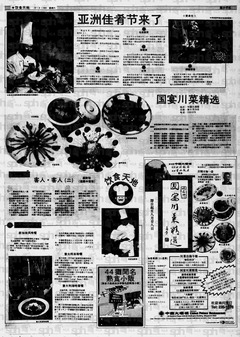 Lianhe Zaobao, 22 August 1987 — Food World
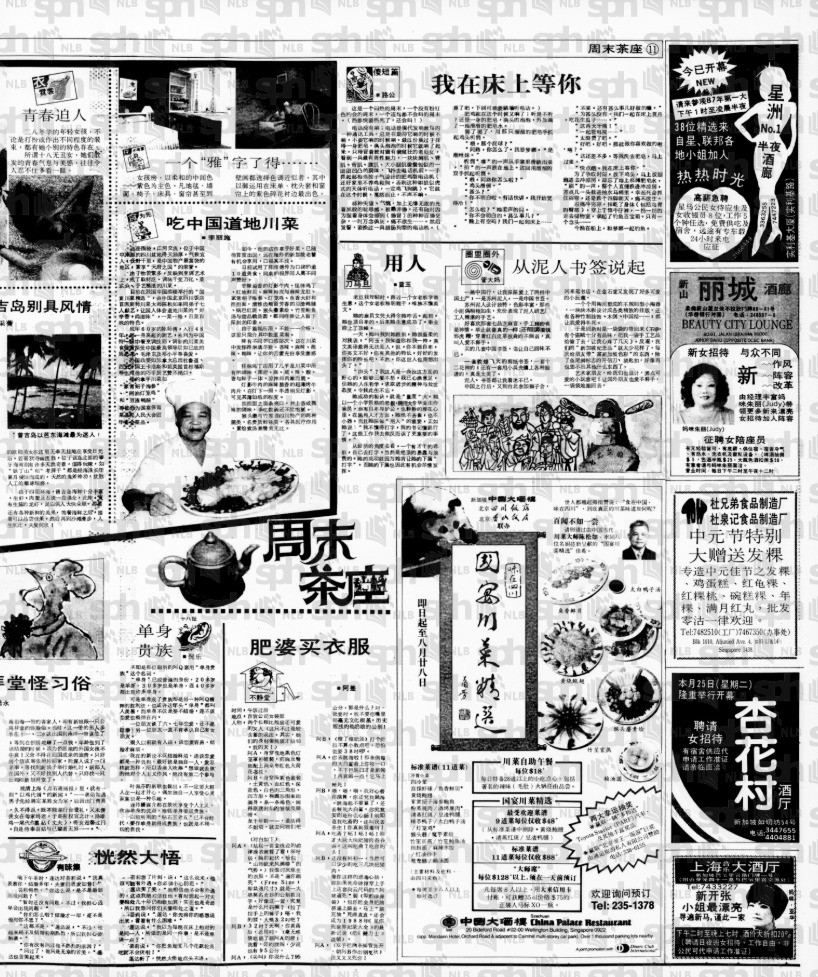
Original clipping →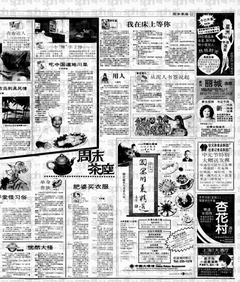 Shin Min Daily News, 22 August 1987, page 11 — Weekend Teahouse
Original clipping →The page images come from NewspaperSG →, the newspaper database of the National Library Board, Singapore; copyright remains with the original publishers. The clippings kept by the family are in the Digital Archive →
-
Aug. 28, 1987 · Closing
The event closed with the local press hailing him as “China’s national treasure of Sichuan cuisine” — a title corroborated by two original newspaper reports of 4 August 1987, in Lianhe Wanbao (南洋·星洲联合晚报) and Shin Min Daily News, plus the Chinese headline of The Straits Times' bilingual feature of 11 August, which read literally “Sichuan's 'National-Treasure Chef,'” together with the videotape preserved by the family. Back in Beijing, he continued working at his post on Xirongxian Lane No. 51 for six more years.
-
Sept. 9, 1987 · Afterwards
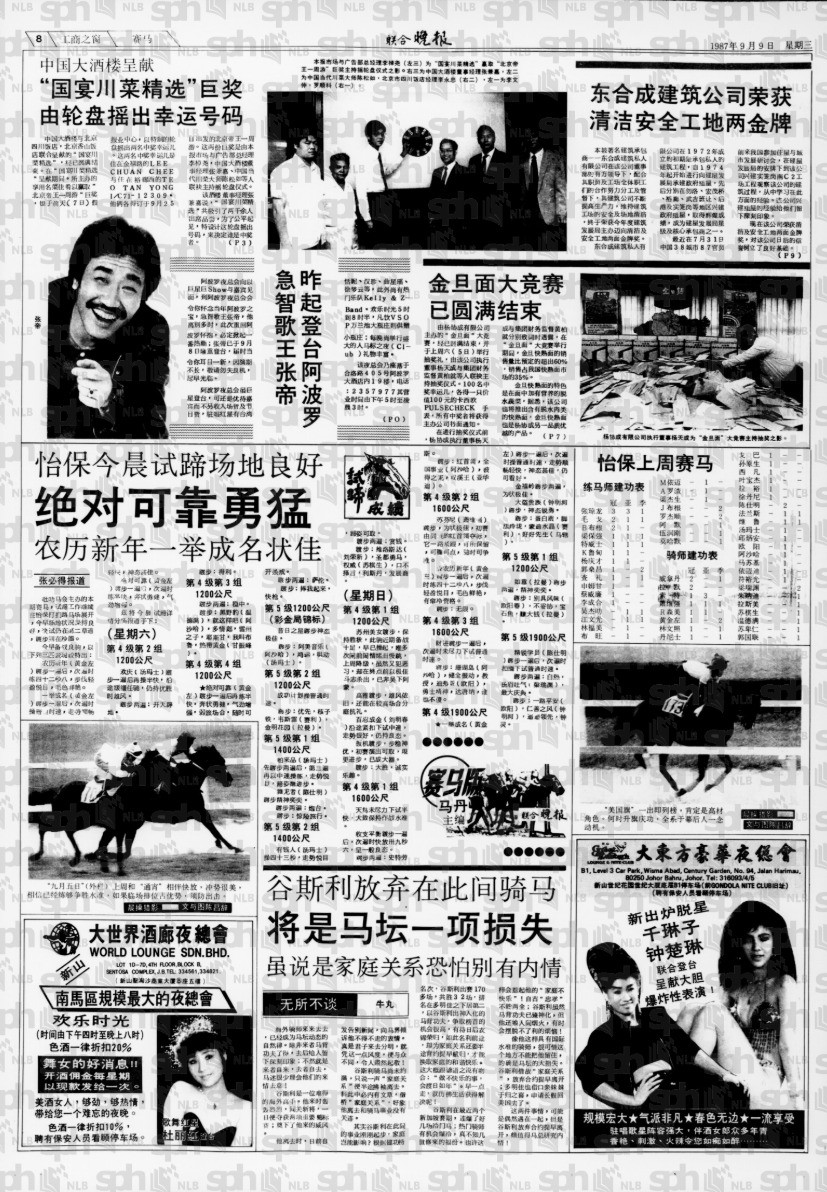
Twelve days after the run closed, Lianhe Wanbao carried the sequel on page 8: the grand prize the China Restaurant had put up for the “State Banquet of Sichuan Cuisine” was drawn by roulette. This page is side evidence of how the whole thing was run — and wound up — as a commercial promotion on the ground.
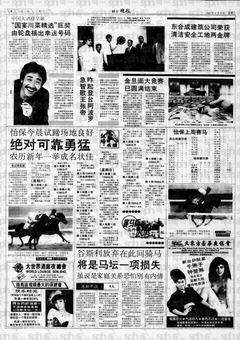 Lianhe Wanbao, 9 September 1987, page 8
Original clipping →The page image comes from NewspaperSG →, the newspaper database of the National Library Board, Singapore; copyright remains with the original publishers. The clippings kept by the family are in the Digital Archive →
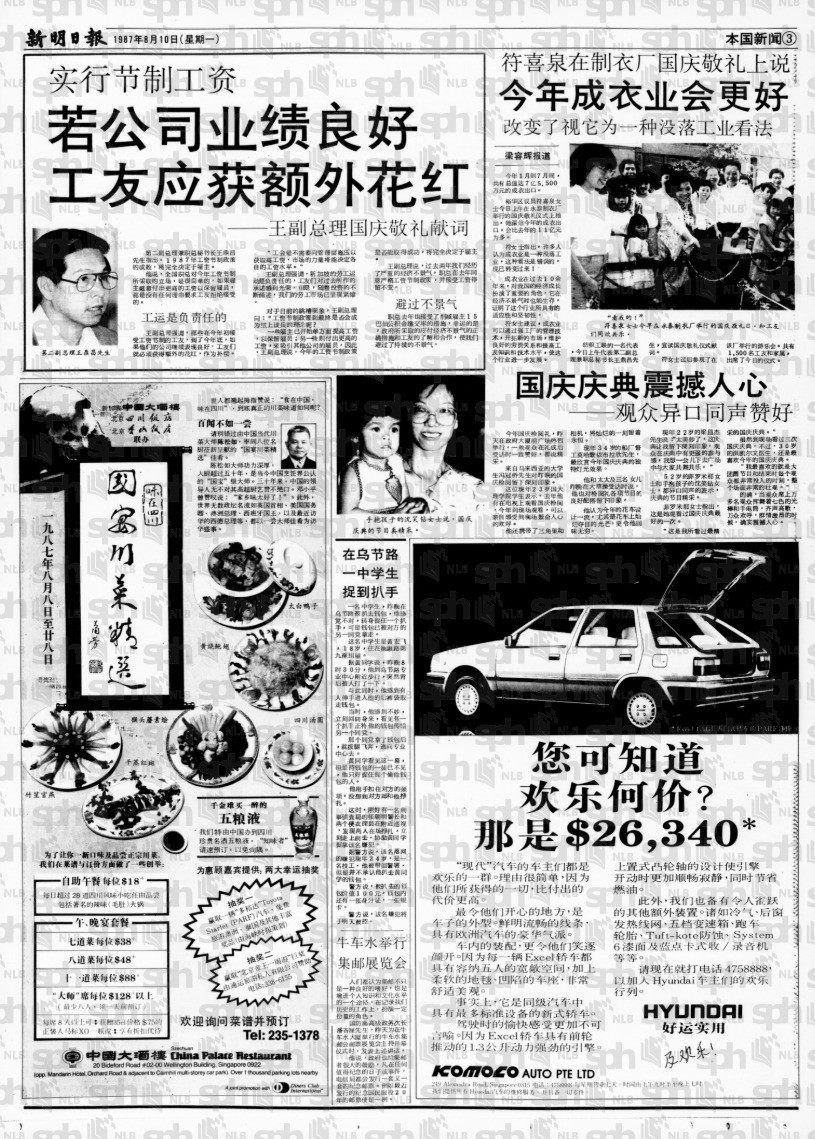
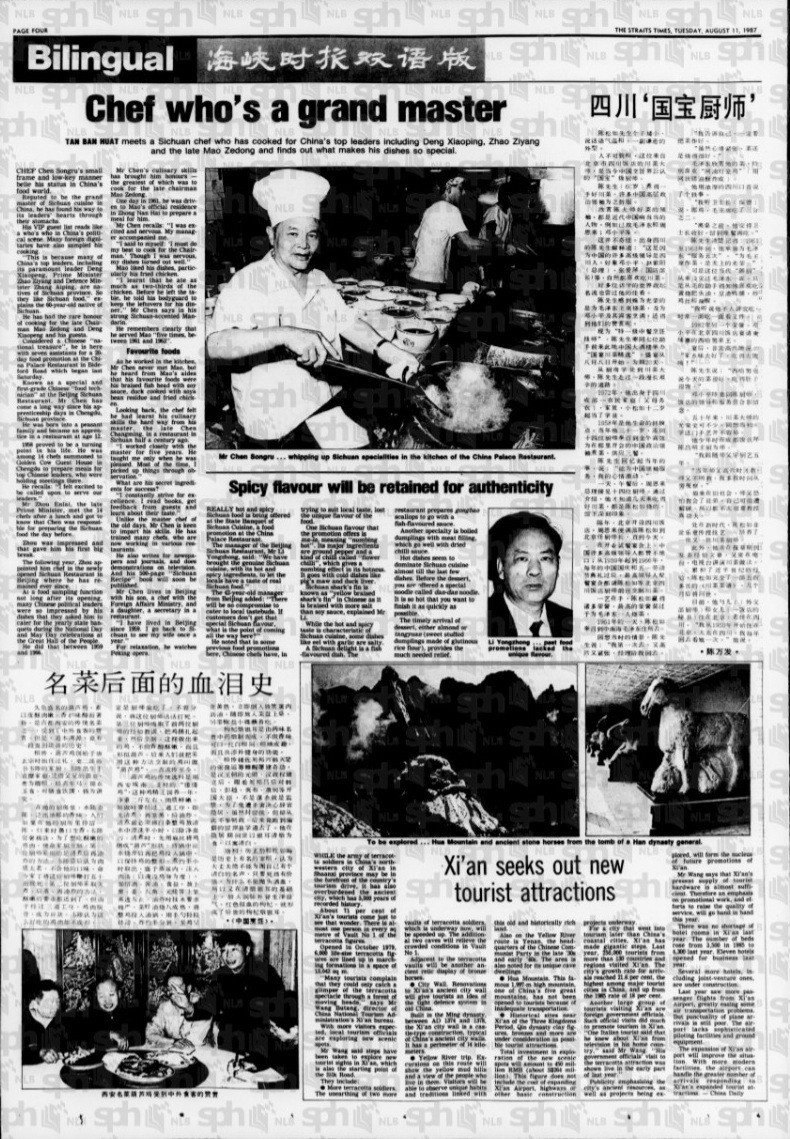
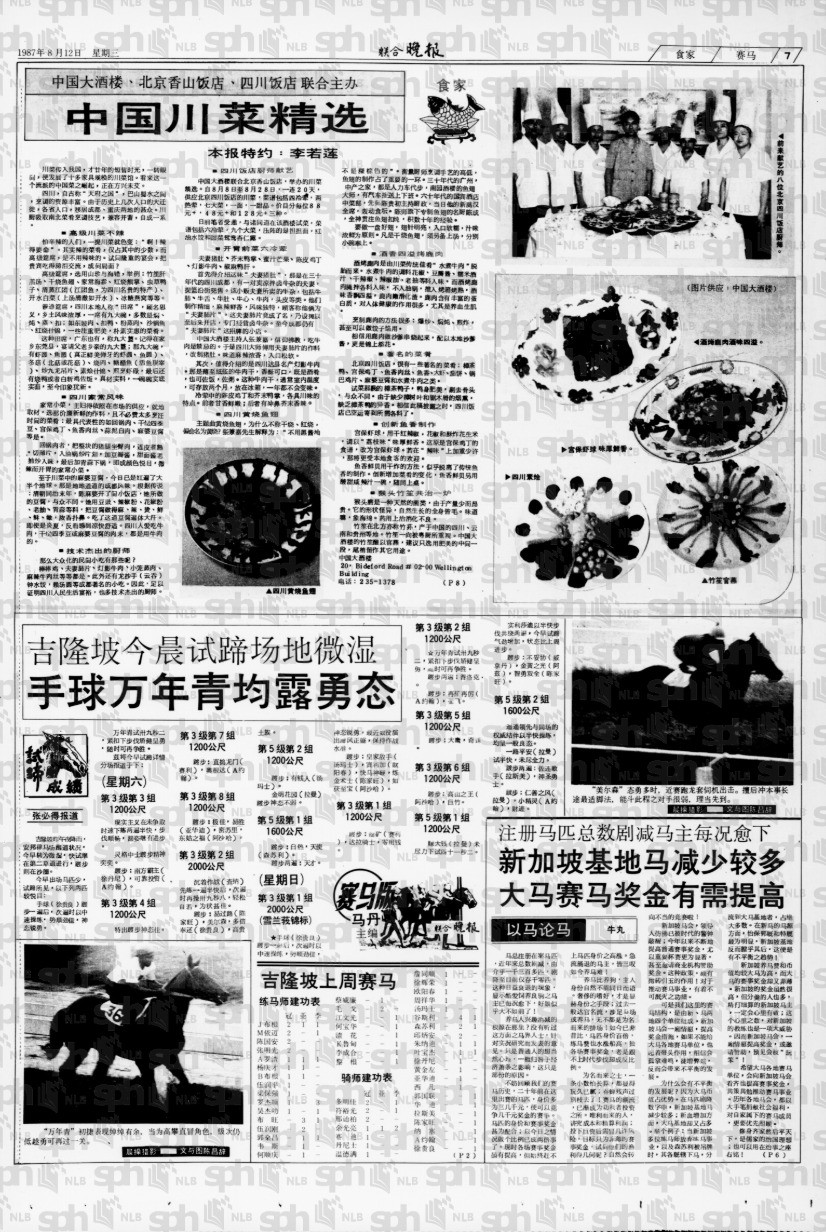
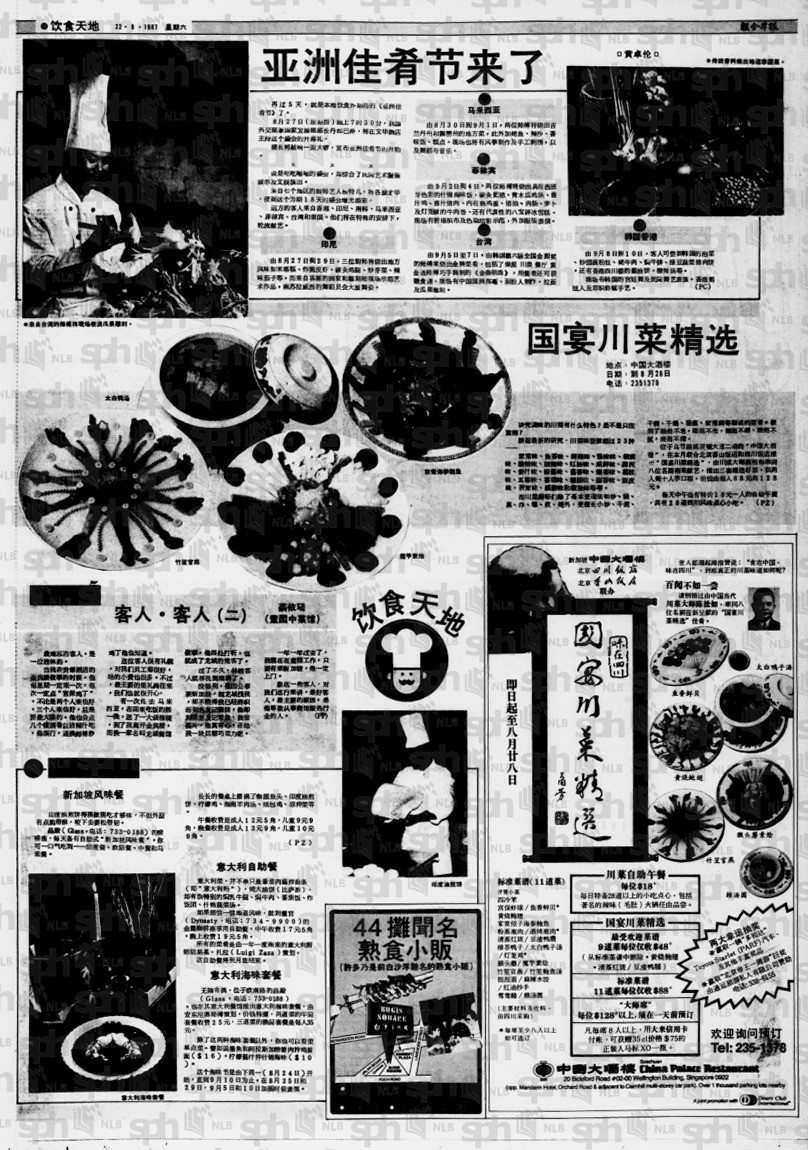
Honest Boundaries
No archival record survives of the team’s day-by-day schedule; the timeline above has been reconstructed from press publication dates and the run of dates shown on the venue banner. The flight route shown is illustrative — the actual flight and any layovers remain uncertain.
The Story of a Videotape
Among the videotapes kept by his family, one (PAL format, 720×576, about 36 and a half minutes in all) carries two separate programmes: the first 28 minutes 8 seconds are the on-site record of the 1987 Singapore trip — the portion published on this page; the remaining seven and a half minutes are a profile film about Chen Songru shot in Beijing, unrelated to the Singapore trip. Its producer (a television station) and date have yet to be established, so it is not included here. In 2025, the family sent the tape to a professional facility to be transferred to digital files; in August 2026, this site de-interlaced, denoised, and organized the transferred master into chapters, and presents it here for the first time.Primary object5
The video is a transfer from a home VHS tape, and its picture quality has the limitations of its era. This site has only de-interlaced and lightly denoised the footage — no AI enhancement or frame interpolation has been applied, preserving the archival footage as it is.First-Hand Object
The Venue & the Menu
Footage · A Tour of the Venue
05:40 · Segment 00:00–05:40“Taste of Sichuan: State Banquet of Sichuan Cuisine” was jointly presented by Singapore’s China Restaurant, the Beijing Sichuan Restaurant, and Xiangshan Hotel. The camera opens inside the restaurant, past dragon-motif decor, sweeping across The Straits Times, 11 August 1987, Page Four — bilingual feature, posted on the wall, the banquet table setting, and a piece of calligraphy dedicated “to Singapore.” About five and a half minutes in, a red-bordered dish nameplate appears — “家常紹子海參” (Home-Style Minced Pork Sea Cucumber) — beside the event’s panda logo: this signature dish of Chen Songru’s stood on the Singapore banquet table under its original Chinese name. The menu booklet was especially distinctive: it printed his biography, a menu that treated the chef himself as the protagonist.
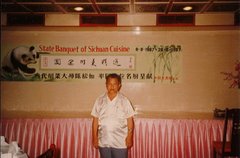 The event venue banner, showing the run of dates and “presented by Chen Songru and eight master chefs”
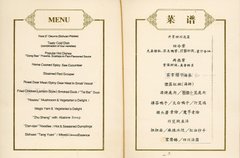 An inside page of the banquet menu, bilingual — corroborated by the dish nameplate seen in the footage
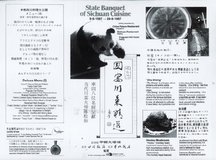 The first page of the menu booklet, printing Chen Songru’s biography
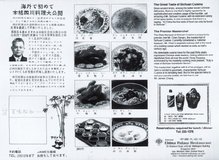 The second page of the menu booklet, with photographs of the dishes
Behind the Scenes in the Kitchen
Footage · Behind the Scenes in the Kitchen
08:00 · Segment 05:40–13:40According to Chen Songru’s own memoir, the eight master chefs on this trip were made up of six from the Beijing Sichuan Restaurant and two from Xiangshan Hotel. This is the densest chapter of the whole film in terms of information: woks catching fire, sauces bubbling, several pans running at once, noodles being pulled and sauced, dishes being plated — every step of the Sichuan kitchen’s 1987 operation is captured on camera. The rhythm of heat control, the pace of turning out dishes, and the division of labor within the team — none of it visible in a still photograph — is laid bare over these eight minutes; the principle of quick stir-frying and the mastery of heat described on this site’s Craft & Dishes → page find their most vivid illustration here. This is, as far as is known, the only surviving footage of this team’s kitchen in action on an international stage.
The Team & the Dishes
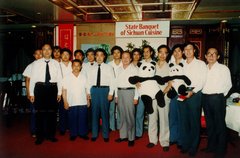 Chen Songru with the team, posing with a panda mascot — the still-photo version of the round-table scene in the footage
Footage · The Team & the Dishes
03:50 · 13:40–17:30The panda was the event’s mascot, appearing on dish nameplates, promotional materials, and group photos alike. In the footage, the white-hatted chef team sits at a round table beneath a panda banner alongside the organizers — the moving-image version of the still photo shown at right. What follows are close-ups of the finished dishes and bilingual dish nameplates (“Sichuan Cold Noodles / SICHUAN…”), which can be cross-checked against the Digital Archive →.
On the menu he said this: “We prepared just these and nothing else, because he had settled what they were, and you were not to go making things up.” What this records is discipline at the point of execution: for the men at the stove the menu was fixed and not to be departed from. As to who fixed it, the family notes that the list was settled jointly by the host, the China Restaurant in Singapore, together with the leadership of the Sichuan Restaurant and of the Xiangshan Hotel in Beijing, not by Chen Songru alone; his part in it was as the person responsible on the kitchen side. This is consistent with the collective selection process for state-banquet Sichuan cuisine documented elsewhere on this site.
Until now this site’s account of the eight-person team rested on Chen Songru’s autobiography alone; it is now independently repeated by someone who was there. The material is a transcript of an oral-history recording and individual wordings have not been checked against the audio by the speaker. He twice says “a month”, slightly at odds with the twenty-one days shown on the banner; this reads as a colloquial rounding, and the banner remains this site’s figure.
Guests & Speeches
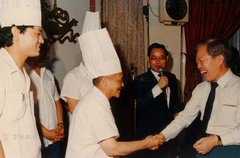 Chen Songru warmly shaking hands with guests from the organizing side
Footage · Guests & Speeches
05:00 · 17:30–22:30Four days before the opening, two newspaper interviews had already told Singapore’s readers the story of a chef who had “cooked for Mao Zedong, Zhou Enlai, and Deng Xiaoping” (see Unit 00). On opening day, guests wearing name badges filed in one after another, and the speeches given in front of a dragon-motif wall panel were recorded in full — the identities of the speakers have not yet been individually verified and are archived here as they are, pending identification; anyone with information is welcome to email us at info@chensongru.com.
A Taiwanese guest’s toast: a business visit before cross-strait family-visit policy took effect
With the toast recording now transcribed and reviewed, the outline of this dinner is much clearer than earlier guesswork: the visitors were a delegation of Taiwan’s refrigeration and air-conditioning trade association, with association chairman Qian as guest of honour; the host was the Kaili Company (the name is a transliteration; its exact written form remains to be verified), represented by general manager Zhang and manager Liu. The speaker called it “a meeting five years overdue”: Kaili laid on dishes and drinks rarely seen in Taiwan and received fellow professionals with “state-banquet-grade” Sichuan cuisine — prepared by none other than the team from the Sichuan Restaurant and the Fragrant Hills Hotel led by Chen Songru. The delegation, for its part, had brought commemorative gifts all the way from Taipei, and Kaili promised to arrange visits and access to materials for the rest of the delegation’s itinerary. Note the timing: this took place in August 1987, nearly three months before Taiwan formally began accepting applications for family visits to the mainland (2 November 1987), when no direct official or semi-official channel yet existed across the strait. Singapore — politically neutral, culturally kindred, and home to a large Chinese community — objectively served in this period as an intermediary for “roundabout contact” between business circles on the two sides. That is the small but concrete sliver of history this footage happened to record.Oral AccountUnverified
The Toast & the Curtain Call · Chen Songru’s Own Voice
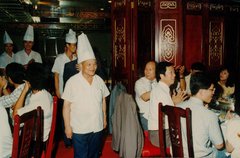 A moment during a walk through the venue, with guests applauding warmly — corroborating the atmosphere captured on film
Footage · The Toast & the Curtain Call
05:38 · 22:30–28:08A toast, a final bow, applause — the film closes with the host’s parting remarks in front of a peacock-feather screen. The senior chef who takes the microphone to speak is Chen Songru himself, and this is his own recorded voice (confirmed by his family) — one of only two publicly available recordings of his voice. 21 days later, the title “China’s national treasure of Sichuan cuisine” traveled back to Beijing along with him.Primary object6
Object-Level Rights Statement
- Videotape ownership: The family (original tape lent for digitization; the party who filmed the 1987 event is unidentified)
- Restoration & metadata: This site (Baiwei Songru digital archive), a non-profit personal project
- Event photographs: Media copyright. For republication or commercial use, contact the original rights holder directly; this site neither exercises nor sublicenses that right.
- Standardized rights statement: In Copyright (rightsstatements.org InC/1.0)
- Permitted use: Images and video here may be viewed and cited for remembrance and research. Any republication, redistribution, or commercial use requires prior written permission from the relevant rights holder.
Beyond the Footage
His 21 days in Singapore earned him the title “China’s national treasure of Sichuan cuisine” from the local press. Back in Beijing, he kept working at his post on Xirongxian Lane No. 51 for six more years, until the very last day of his life. For more artifacts and records of this chapter of his life, follow these threads onward.
Sources
- Independent sourceThe title “national-treasure master of Chinese Sichuan cuisine” is confirmed by a videotape kept by the family (digitised and released August 2026) as having been conferred by the Singapore press during the 1987 visit. Two original press reports corroborate it: Ou Fuli, “A Flash of the Spatula: Mao Zedong Got Hooked — Sichuan Master Chen Songru’s Real Skill”, Lianhe Wanbao (南洋·星洲联合晚报), 4 August 1987; and Zhou Yuqin, “Master Chef Recounts: Deng Xiaoping Loved Yu-Xiang Rapeseed Greens, Same Tastes as Mao Zedong and Zhou Enlai”, Shin Min Daily News, 4 August 1987. A third piece corroborates it word for word: the Chinese headline of The Straits Times' bilingual feature of 11 August 1987 reads literally “Sichuan's 'National-Treasure Chef.'”↩
- Independent sourcePrime Minister Lee Kuan Yew’s visit to the China Restaurant to taste the food is supported by three independent strands of evidence: a group photograph taken on site, the film kept by the family, and the two Singapore newspaper reports of 4 August 1987 cited above.Biographical account The specific wording of his comments on the yu-xiang prawn rolls and the camphor-tea duck is at present found only in the biographical manuscript, chapter 12, section 4, with no independent corroboration. This site labels the two by evidence tier and does not treat them as equivalent.↩
- First-hand accountChen Songru’s autobiography records that the delegation to Singapore consisted of six people from the Sichuan Restaurant and two from the Xiangshan — eight master chefs in all. The family’s film and the group photographs, digitised and released in August 2026, provide direct visual corroboration of this composition.↩
- Primary objectPhotographs of the venue banner (provided by the family; related group shots catalogued here in the PH-028 series) and the family’s film both show the run of dates “8-8-1987~28-8-1987” and the wording indicating a joint presentation by the China Restaurant Singapore, the Beijing Sichuan Restaurant and the Xiangshan Hotel.↩
- Primary objectOne videotape kept by the family (PAL, 720 × 576), about 36 and a half minutes in all. Its first 28 minutes 08 seconds are the footage of the 1987 Singapore visit, which is what this page publishes; a further seven and a half minutes at the end of the tape are a profile film shot in Beijing, producer and date still to be established, not included here. The family had it transferred to a digital file by a specialist facility in 2025; this site published it for the first time in August 2026 (deinterlaced and lightly denoised only — no AI enhancement, no frame interpolation).↩
- Primary objectThe older chef speaking into the microphone in Unit 07 of the film (22:30–28:08) is confirmed by the family to be Chen Songru himself. It is one of two records in publicly available material in which his own voice can be heard; the other is the 1991 profile film held in a separate exhibition on this site.↩