
Life Journey
From a famine-stricken boy in Miaoshan Village, Laojun Town, Ziyang, Sichuan, to the first Executive Chef of Beijing’s Sichuan Restaurant and master of state banquets. The following timeline is compiled from the biography Song’s Breeze in Cuisine, his own autobiography, family oral accounts, and independent media reports. Where discrepancies exist, they are presented side by side without forced reconciliation.
A Lifetime’s Geographic Trail
Evidence strength: First-hand account autobiography or direct disciple witness · Physical evidence certificates, original copies or order receipts · Independent source cross-verified by third-party media · Biographical account found only in the biography · Unverified conflicting accounts across multiple sources
From Ziyang to Chengdu, and then to Beijing; along the way he also went to Chengdu and to Singapore, before returning to Beijing at last.
Seventy-One Years at One Stove
Confirmed by official eulogy
Born December 7, 1921, into a poor farming family, the seventh child. For a long time, two notations — “1920 (lunar) / 1921 (Gregorian conversion)” — coexisted, along with a third version of “1927” from a 1987 official submission. In July 2026, a newly obtained formal biographical summary/eulogy written by his employer in the month of his death (January 1993) clearly records “born December 7, 1921,” confirmed by the family. This site adopts that date accordingly.1
Hunger and poverty became the enduring undertone of his life, shaping a decision-making approach that blended altruism and self-interest.
(age 9)
After a severe drought in Sichuan triggered a locust plague, Chen Songru organized neighborhood children to catch and roast locusts, distributing them to the starving. Later, he was beaten after stealing sorghum from a landlord’s granary, but refused to betray his accomplices even under torture.
The origin of a “problem-solving plus altruism” spirit, and the prototype of his loyalty and resilience under pressure.
(age 12)
Left home alone before dawn, passing through Jianyang and crossing the Longquan Mountains, arriving in Chengdu after two days and one night to seek refuge with his second brother. After repeated rejections, he won over the owner of the “Taole Tian” restaurant by sweeping the front entrance clean every day for five consecutive days, earning a three-month trial period.
The core pattern — actively pursuing one’s ideals, proving through action rather than words — was established from this point onward.
1936.5—1939.1
First-hand account
First apprenticed at Minsheng Restaurant under “Three-Precision Master” Zhou Guangting to learn knife skills and heat control (his motto: “steady knife, calm heart, only then can you see the ingredient’s true flavor”; his teaching was famed for precision — “from the first plate to the twentieth, every dish for twenty tables had identical portions, nothing left in the wok, nothing short”). Later, at Chengdu Restaurant, he apprenticed under “Master of the Pulse” Chen Changming to systematically learn Sichuan culinary arts; Chen remarked, “This boy has fire in his eyes. When the heat is right, the ingredients speak; when the inner fire burns bright, a dish finds its soul.” He had previously trained at Taole Tian restaurant until it closed in March 1934.Exact start and end dates confirmed by Chen Songru’s own autobiography (newly obtained July 2026), previously known only as the approximate “1934-1938” combined period.New discrepancy, July 2026: Two older family documents from 1987/1988 mention only “apprenticed at Taole Ju in Chengdu under Chen Changming” (“Taole Ju” is likely a variant rendering of “Taole Tian,” the same restaurant), with no mention whatsoever of Zhou Guangting or Minsheng Restaurant, contradicting the autobiography’s precise timeline of “two masters.” Both accounts are presented side by side without judgment. According to a self-media article, this apprenticeship period involved “poor working conditions, overwork, and no money to see a doctor when ill,” leaving him with a leg injury that lasted the rest of his life. In August 2026 the same wording, almost verbatim, was found in “A Sichuan Wind at the State Banquet” (2017); the closeness of the phrasing suggests a common upstream source rather than independent corroboration.2
(age 17–18)
Solo-prepared twelve dishes including “Kaishui Baicai (cabbage in a clarified superior broth)” (Kai-shui Bai-cai). General Pan Wenhua praised him, saying “Great skill belies an unadorned hand.” Thereafter, he regularly catered banquets at the residences of Sichuan military commanders, with tips rising from fifty copper coins to two hundred.
Stricken by a severe illness from overwork and dismissed by the restaurant. During his recovery, he met Jiang Mingshu. After recovering, he formed a mobile banquet team while volunteering at military factory mess halls and field medical stations, winning over Northwest China military and political personnel with his Sichuan cuisine.
The conviction that “every citizen bears responsibility for the nation’s fate” was established — cooking was not only a livelihood but also a way to serve the country.
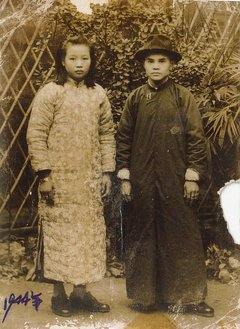
A simple wedding in the winter of 1944. In 1947, he joined Chengdu’s Duoyi Canteen, ending seven years as an itinerant chef and undergoing even more rigorous technical training (once cutting fifty jin of potatoes in a single session to hone his knife skills). A political record added in August 2026 (from a family article of 1988): on the eve of liberation he joined Zhang Deshan and Chen Banglin in leading a labour movement among Chengdu’s cooks, serving as a workers’ representative and taking the proprietors to court. After 1949 he took part in the “three-anti and five-anti” campaigns and the conversion of private firms to joint ownership, serving as deputy chairman of the union; on that account the government had him schooled up to upper-primary level. This site had recorded only that he was “progressive-minded”; the concrete history behind that phrase had been blank.
During his time at Duoyi Canteen, he cooked “Crispy Sauce Pork Hock” (Jiaopi Zhuzi) and “Braised Assorted Meats” (Hongshao Shijin) for famed Sichuan ventriloquist Zeng Bingkun, combining Master Zhou Guangting’s “precise heat control” with Chen Changming’s “swift hands” and adding his own researched color and flavor innovations. Zeng was so impressed that he frequently incorporated the dishes he had eaten into his stage performances and promoted them tirelessly.Chen Songru’s own autobiography3
Click to enlarge.
Duoyi Canteen catered the Chengdu forums for representatives from all walks of life and the banquets for the First People’s Congress. During the Korean War, he hosted meals for volunteer soldiers more than twenty times, each serving 1,000–2,000 men, designing a “Farewell Feast” to send troops off to battle.
Served as both manager and executive chef. Joined the Party the same year. The exact year is disputed: his direct disciple Xiao Jianming recalled it separately as “joined the Party in 1957,” while the 1993 official eulogy from his work unit records “March 1959” — a roughly two-year gap. Both accounts are presented as-is, without reconciliation.Independent source4
First-hand account
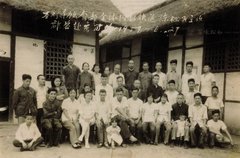
The trial meal date is disputed (the autobiography states August 4; eldest son Chen Tinglong’s article states August 28), but both accounts agree on the official opening of October 1. A team of 34 chefs began work that July. At the opening trial meal, Zhu De addressed them (full version newly obtained July 2026): “Qinghai and Hubei have already come to Beijing to open restaurants. Now that Sichuan has arrived, you must get the Sichuan flavors right — don’t mess with them arbitrarily… Stay true to Sichuan flavors… If someone wants twice-cooked pork but can’t handle chili, serve them sauce-exploded pork instead, and tell them to come see me.” Guo Moruo added: “Stick to authentic flavors. Plating should be generous, not vulgar.”5 One detail of the opening, added August 2026 (from the article “Recollections: A Short History of the Beijing Sichuan Restaurant”): on the first day, National Day, only two main dishes were served — duck breast with bean lees and dry-braised bighead fish. The scale was far plainer than later imagination has it.The same source records the scale of the selection: once word went out that the centre wanted cooks from Sichuan, more than a hundred senior chefs were put forward from Chongqing, Chengdu, Zigong, Nanchong, Yibin, Xinjin and Luzhou. Chen Songru was chosen from that field. Single source · Zhangshang Ziyang / Du Xianfu (2018)
The transition from folk cook to founding figure of the state banquet system. The external precept “authenticity must not be lost” profoundly shaped his professional ethics.
Click to enlarge.
Disciple’s account
Per a recollection by disciple Liu Zihua: during the restaurant’s trial-meal preparation, Zhou Enlai, on an inspection visit, specifically asked “Where’s the dining room where ordinary people can try Sichuan cuisine?” and instructed that “while hosting banquets, don’t forget to leave a place for ordinary people to try Sichuan food” — on the spot designating the “Erbei” (North Building No. 2) dining room as the walk-in area for regular customers. Chen Songru and the senior chefs used this to teach the younger cooks: "Only if you can make the à la carte dishes well can you possibly make the banquet dishes well. If you can’t make fish-fragrant shredded pork properly, you won’t be able to make fish-fragrant prawns; if you can’t make Gong Bao diced meat properly, you won’t be able to make Gong Bao chicken; if you can’t make home-style squid properly, there’s no way you’ll be able to make home-style minced pork sea cucumber!"6
A supplementary case for the “cooking mirrors character” model: care shown in the basics determines the quality of the advanced results.
First-hand account
Prepared “Net-Oil Lantern Chicken” (Wangyou Denglong Ji). Chairman Mao ate half and asked to save the rest for the evening. Since net-fried dishes cannot be re-wokked, Chen Songru returned to the restaurant that night to make a fresh portion, presenting it as the half-eaten leftover from lunch — all to ensure the “crispy outside, tender inside” quality was delivered as intended. Afterwards, Chairman Mao had his staff send over cigarettes and apples as a token of thanks — one account says grapes from the courtyard instead; the two records of the actual gift do not agree, and both are presented as-is.The dish’s name is disputed: in an essay recounting this same episode, disciple Liu Zihua consistently calls the dish “Net-Oil Pouch Chicken” (Wangyou Hebao Ji); yet later in the same essay, a 1974 dish list names “Net-Oil Pouch Chicken” and “Net-Oil Lantern Chicken” as two separate dishes served side by side. This site has so far used “Net-Oil Lantern Chicken,” based on the wording in Chen Songru’s own autobiography — the two primary/near-primary sources disagree on the name, and both are recorded as-is without forcing a judgment.7
The most solid behavioral evidence of his principle “a dish reflects one’s character”: he would rather work through the night to guarantee quality than cut corners.
Unverified
In his autobiography, Chen Songru wrote: “Chairman Mao originally planned to host King Norodom Sihanouk at the Great Hall of the People… but then it was suddenly moved to Zhongnanhai,” requiring his team to urgently relocate and prepare the meal. Afterwards, “Director Li of Zhongnanhai repeatedly expressed his gratitude, saying we had ‘rendered outstanding service.’”The year is disputed: the autobiography gives no precise date, loosely placing it around 1961; the official website of Quanjude Group (parent company of Sichuan Restaurant), in its “Centennial Memories” column, clearly records it as “October 5, 1964” — also the Great Hall moved to Zhongnanhai, also hosting Sihanouk — very likely the same event. Both sources have formal provenance; they are presented side by side without reconciliation.
Echoes the “action over words” pattern — after the task was completed, the action itself earned recognition.
First-hand account
Entered Zhongnanhai three times to cook for Mao Zedong, and regularly served Zhou Enlai, Zhu De, and Chen Yi. Zhu De’s instruction: “Stay true to Sichuan flavors… If someone wants twice-cooked pork but can’t handle chili, serve them sauce-exploded pork instead, and tell them to come see me.” Chen Yi once scored dishes such as Pineapple Cool Fermented Rice (Boluo Liang Laocao) one by one. In 1961, hosted Indonesian President Sukarno. North Korean Chairman Choe Yong-gon, visiting Beijing in 1962, tasted “Home-Style Minced Pork Sea Cucumber” (Jiachang Shaozihaishen) and subsequently facilitated a North Korean culinary study delegation — 32 people across two batches — on a year-and-a-half exchange visit; upon their return, North Korea awarded Chen Songru the “Order of the Thousand-Li Horse of the Democratic People’s Republic of Korea.”New discrepancy, July 2026: Earlier records state the medal was awarded during a “third visit by a North Korean delegation in March 1986” (single source), a 24-year difference from the “1962” indicated by newly obtained materials. Both accounts are presented side by side without forced determination. Three additions, August 2026 (from “A Sichuan Wind at the State Banquet,” 2017, which is marked as reprinted from “360doc” and is therefore not an original source): a detail of Mao Zedong’s taste — “he liked plain stir-fried chilli, and every meal kept bitter melon fried with chilli, dry-tossed in oil”; in 1962, after eating in Shanghai, Zhou Enlai remarked that “the Sichuan Restaurant’s boiled cabbage in supreme broth is still the best,” after which the Jinjiang Hotel, the Overseas Chinese Mansion and the Park Hotel in Shanghai each sent people to Beijing to learn from Chen Songru. The same article dates Choe Yong-gon’s visit and the study of home-style sea cucumber to 1963, a year later than the 1962 recorded here; both stand as they are. The scale, added August 2026 (from Chen Songru’s 1988 manuscript): the Korean delegations came in two groups, fourteen in the first and eighteen in the second — together the thirty-two already recorded here — with Chen Songru as their group leader. On the third visit in 1986, the last day was given to an exchange of technique, and the Korean chefs cooked four dishes of their own.
Formed a life philosophy of “neither too close nor too distant” — forthright without flattery (the cigarette incident).
When confronted with house-searches and pressure, he defused the conflict by invoking a higher rule: “Tonight’s banquet guests are mostly foreign dignitaries… surely you can’t refuse to serve?” — neither confronting head-on nor groveling. After the Cultural Revolution, when Yang Shangkun expressed concern about his ordeal, he simply replied, “It’s in the past. All in the past.”
Zhou Enlai (already ill) proposed rebuilding the Sichuan Restaurant. After an inner struggle, Chen Songru agreed to return to Beijing. The number of preparatory chefs is disputed: one account says “led more than thirty young and middle-aged chefs in preparations”; Chen Songru’s own autobiography states “only need 12 chefs” —newly obtained July 2026, an article written by Chen Tinglong in 1988 gives a more detailed two-wave composition: “In February 1973, Father led Tang Wen’an, Jiang Huichao, Chen Tinglong, and more than thirty other young and middle-aged chefs to begin rebuilding; later, more than thirty young chefs were selected from Chengdu and Chongqing.” None of the three accounts fully agree on the numbers; they are presented side by side without reconciliation. The restaurant had been formally dissolved at the end of 1969, with Sichuanese staff repatriated. In January 1973, Chen Songru returned to Beijing; it reopened in March of the same year, but due to political circumstances could not use the name “Sichuan Restaurant” and was instead called“Chengdu Restaurant” (Chengdu Fanzhuang), with Chen Songru still serving as executive chef — this former name had long been in doubt, but was confirmed in 2026 after cross-verification from three independent sources.Three independent corroborationsRegarding the year the original name “Sichuan Restaurant” was restored: Chen Songru’s autobiography and editor’s notes both record 1976 (after the fall of the Gang of Four), while other materials suggest it continued until 1978–1979. Both accounts are presented side by side.8
First-hand account
After tasting Sichuan cuisine, the King praised it, saying “China’s Sichuan cuisine truly lives up to its reputation.” A home dinner, added August 2026 (from the same neighbour’s memoir): in May 1990 the writer entertained four guests, with Chen Songru himself setting the menu and cooking — squid with crisp rice, kung pao diced pork, mapo tofu, cabbage hearts with straw mushrooms, and hot-and-sour soup, together with three small cold plates, a serving each of fermented-rice pudding and cold jelly, and cold noodles; a friend at the table said he now knew what “four dishes and a soup” meant. The same piece names lantern-shadow beef among his best dishes, and offers a rare outsider’s sketch of the man: “Master Chen always had a smile on his face; he was sparing of words and not much of a talker.” That is a different brushstroke from the biography’s ever-quotable mentor; the site keeps both.
Corroborated by physical receipt
Deng Xiaoping exclaimed, “Today I get to taste my hometown’s tofu pudding again — it’s wonderful!” The original banquet order receipt retained by the Sichuan Restaurant (header handwritten “Nov 5, 82”) matches the autobiography’s account and is the highest-reliability physical evidence in this archive. The dates “July 21” and “Autumn 1983” given in other family articles are likely post-hoc memory errors.New evidence, July 2026: The official publication The True Craft of China’s Sichuan Cuisine Masters: Chen Songru includes a menu draft in Chen Songru’s own handwriting titled “Sihanouk’s 60th Birthday Menu,” with the caption stating “Deng Xiaoping hosted a banquet of seven tables to celebrate Prince Sihanouk’s sixtieth birthday…” — the date matches this event, confirming that “Sihanouk’s 60th birthday” refers to this very banquet and was not a separate event. The earlier suspicion of an independent event in “Autumn 1983… after fourteen years apart” is now resolved.9 A further exchange recorded, August 2026 (from “A Sichuan Wind at the State Banquet,” 2017, a reprint): Sihanouk said, “the food today was very good — I have eaten myself round”; Deng Xiaoping said, “the taste of home is too good; eating here is far too comfortable,” and had a photograph taken with Chen Songru and the other chefs. The wording differs from the line already recorded here — “today I have tasted the bean curd of home again, and it is very good” — and is presumably another retelling of the same banquet; both stand side by side. A comparison of participant memory with the physical menu, August 2026: the chef Zhou Shengping recalls that Chen Songru assigned him two dishes — mala fengwei and yuxiang duck squares. The first matches, word for word, a cold dish on Chen Songru’s handwritten menu: the first direct corroboration on this site between a participant’s memory and a physical record. The second is not among the menu’s thirteen hot dishes; the menu carries “yuxiang prawns” and “bean-lees duck breast,” and the recalled name appears to be a crossing of the two. Note that this is a judgement made from the menu, not a correction by Zhou Shengping himself; should he confirm the name when checking the recording, it should be restored.
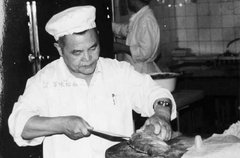
In 1981, at age 60, he was eligible for retirement but declined a “generous salary plus housing plus family reunion” offer from the Beijing International Hotel. In 1986, at the mandatory retirement age of 65, he again declined a paid figurehead role and instead accepted the position of Culinary Director, with a monthly salary of just over 300 yuan.
The core pillar of the “indifferent to fame and fortune” narrative, though the biography does not record whether he ever wavered or hesitated.
Click to enlarge.
First-Hand Object
According to a self-media article, Chen Songru “was once elected as a representative to the Beijing Municipal People’s Congress”; a physical representative certificate provided by the family (dated December 10, 1981) corroborates this record — see Digital Archive PH-012.
A facet of his social standing running parallel to his culinary achievements, not previously recorded on this timeline.
Confirmed by physical order receipt
Together with his disciple Liu Zihua, he was personally named by Deng Xiaoping to take charge of the cooking. Both were praised — “I’m eating hometown specialties again — wonderful!” — and each received a bottle of Feitian Moutai and a Great Hall wall calendar. The year had previously existed in two versions, “1984” and “1985.”New evidence, July 2026: The True Craft of China’s Sichuan Cuisine Masters: Chen Songru includes a physical order receipt retained by the Sichuan Restaurant, clearly marked “January 1, 1984,” hosted by “Deng Xiaoping, Hu Yaobang,” 2 tables for 22 people, perfectly matching the autobiography’s New Year’s gathering scene.“New Year’s Day 1984” is now upgraded to physical confirmation; “1985” was likely a year misremembered during third-party biographical retelling. Both versions are still archived side by side. The dishes of that day, added August 2026 (from Chen Tinglong’s oral material): on tasting the clear-broth mushroom bean-flower Deng Xiaoping said, “today I have had bean flower”; then came yuxiang rape shoots, husband-and-wife lung slices, strange-flavour shredded chicken and Sichuan pickles, after which he made the remark above. Note also that a reprinted article of 2017 places this gathering on “New Year’s Eve 1983, twenty-two central leaders,” which differs considerably from the “1 January 1984, two tables, twenty-two people” confirmed here by the physical order slip. Both are set down; this site still follows the slip.
Physical certificate
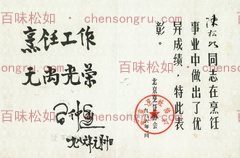
The honorary certificate bore the inscription “Culinary work, boundless honor,” recognizing his “outstanding achievements in the culinary profession.”July 2026: Family provided a scanned copy of the physical certificate; the signatory was confirmed by the family to be Xi Zhongxun (then Vice Chairman of the Standing Committee of the National People’s Congress).
Click image to view original full size
Unverified
According to the 1993 official eulogy from his work unit, he received this title at Beijing’s first special-grade technician commendation ceremony, the same year he declined a paid endorsement offer and stayed on as executive chef at a monthly salary of just over 300 yuan. The exact year is disputed: his direct disciple Xiao Jianming recalled separately that “the Beijing Municipal People’s Government approved him as a special-grade chef in 1978” — an eight-year gap from 1986. Both accounts are presented as-is, without reconciliation.He had already been writing about food for a general readership: on 21 January 1984 he contributed to the “Home Cooking” column of the Beijing Evening News — one of the earliest firm dates for his writing the craft of the stove down for ordinary readers. Independent source · Beijing Evening News (caption in Liu Zihua’s article)
First-hand account
According to his direct disciple Xiao Jianming’s oral account, in 1987 he was sent by the Sichuan Restaurant to lead the effort to establish a branch in Jiamusi, Heilongjiang — a concrete example of the restaurant’s expansion and its transmission of Sichuan culinary skill to northern cities. This is currently documented only in Xiao Jianming’s single oral-history account and awaits further independent corroboration.10
Physical reproduction
A 21-day engagement. Singapore’s Prime Minister Lee Kuan Yew personally attended to taste the dishes; local media reported under the headline “National Treasure-Level Chinese Sichuan Cuisine Master.” That autumn, he returned to Zhongnanhai to chef for Hu Yaobang’s banquet hosting Burmese guests, and was unexpectedly asked to serve “Dandan Noodles” first — he handled it with composure.Newly added July 2026: Chen Songru’s autobiography clarifies that the eight-person team comprised “six from the Sichuan Restaurant and two from the Xiangshan (Fragrant Hills) Hotel,” not all of whom were his direct disciples or colleagues from the Sichuan Restaurant. The earlier default assumption that all “eight disciples” were his own students needs clarification. A third figure, added August 2026: the work-unit eulogy of January 1993 says “six disciples,” which does not contradict the autobiography’s “eight” but counts differently — two of the eight came from the Xiangshan Hotel and were not his students. Zhou Shengping’s eyewitness account independently repeats the structure “six from the Sichuan Restaurant plus two from the Xiangshan,” which turns this reading from inference into confirmation.
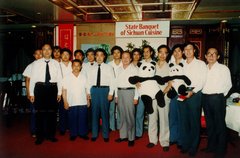
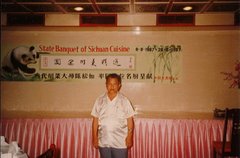
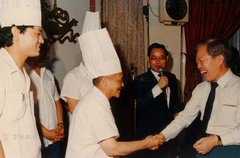
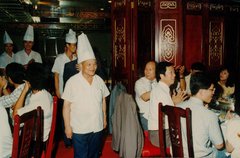
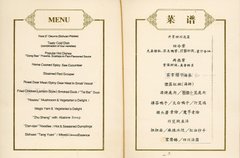
Click to enlarge; more original newspaper clippings can be found on the News & Reports page under “Original Clippings.”Physical reproductions
Physical certificate
The honorary certificate recognizes his “contribution to the development of China’s culinary profession over more than thirty years,” issued by the China Culinary Association, elevating the honor from the 1986 municipal Beijing level to a national recognition.July 2026: Family provided a scanned copy of the physical certificate and confirmed the year is 1989. Although the year field shows signs of alteration, the family confirmed it is correct; the specific month and day characters are not fully legible.
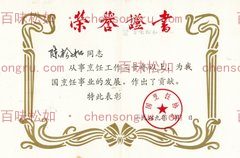
Click image to view original full size
January 1989 — Sichuan Restaurant Cookbook (Sichuan Science and Technology Press), first print run of just over 9,000 copies — apart from his own 50 copies, all were given away by the restaurant and not sold commercially. December 1991 — 160 Authentic Sichuan Dishes (Jindun Press), reprinted 17 consecutive times, becoming a mass-market bestseller.Click the titles to view scanned digital editions on the “Craft & Legacy” page.
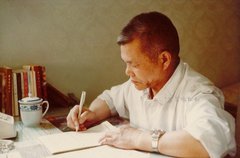
Click to enlarge.
Physical certificate
Certificate No. 009, appointing “Special Grade Culinary Technician Chen Songru” as instructor for a five-year term, bearing a circular red seal.July 2026: Family provided a scanned copy of the physical certificate. The issuing authority’s seal text is blurred and cannot be fully identified; this is marked as pending verification.
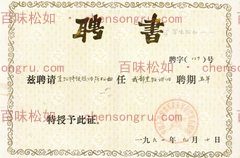
Click image to view original full size
Disciple’s account
According to Xiao Jianming’s oral account, while posted to work at the “Jinshuiyuan” restaurant, he had an opportunity to transfer back to the Beijing Sichuan Restaurant, but after weighing his options chose to stay and continue running the operation. When Chen Songru learned of this decision, he expressed his support with tears in his eyes rather than insisting Xiao return to Beijing. This detail echoes the mentor-disciple pattern of “transmission through objects and craft rather than words” (see the Wisdom → page) — showing respect for a disciple’s personal choice rather than one-way instruction from the master.
“First” designation disputed
On the day of the ceremony, the restaurant specially opened the main gate of its central courtyard, and a red carpet was laid all the way from the drop-off point at the first courtyard to the venue in the third courtyard. Officials from the Ministry of Commerce, the Beijing municipal government, the China Cuisine Association and the Beijing Cuisine Association attended to offer congratulations, along with previous award-winning chefs from France, Germany, Italy and other countries. Chen Songru was as delighted as a child in those days, and when he appeared to the welcoming music, the normally easy-going man even seemed a little shy. The presenter first read the citation in a foreign language; only after it was translated did the whole hall break into warm applause. He then opened a gift box and took out a pristine white “ceremonial robe” embroidered with the five-starred red flag and the national emblem — Liu Zihua called it “the chef’s world’s version of the imperially bestowed yellow jacket” — first displaying it to everyone before personally dressing Chen Songru in it; the moment the last button was fastened, the atmosphere in the hall reached its peak, and several foreign chefs stepped forward to offer congratulations and toast with him, after which Chen Songru gave a speech of thanks. The biography calls him “the first Chinese chef to receive this honor,” but both independent sources and his disciple Liu Zihua’s own account state “the only one in China that year” — these are not entirely equivalent. This site adopts “the only one in China that year” as the accurate phrasing.11 Under the association’s rules, every recipient had to be filmed at work in the robe as a permanent record; according to his disciple Liu Zihua, who was present, the dish he cooked for the camera was mapo tofu, and every dish served at the banquet that day was likewise personally decided and prepared by Chen Songru himself.
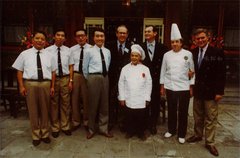
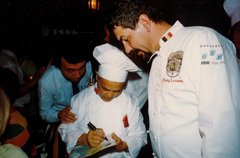
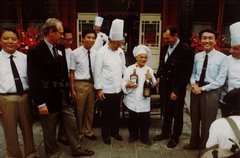
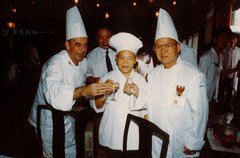
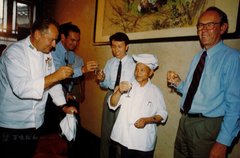
The above 5 photos are color images from the event provided by the family. Click to enlarge.Physical reproductions
According to the China Catering Services Yearbook 1993, this was the World Master Chefs Association's 15th Annual Conference (25–30 August, held in Beijing, including off-session activities such as the award ceremony at the Sichuan Restaurant); the in-session proceedings (at the Great Hall of the People) opened on 25 August and closed on 29 August, and on the closing day Wan Li, then Chairman of the NPC Standing Committee, met with all attending members, while the association's Secretary General Gilles Bragard presented Wan Li, on the association's behalf, with an honorary membership certificate and a robe embroidered with China's national flag and emblem. The association was founded in 1977, initiated by France's Baccarat crystal company and L'Oréal, as a non-profit, non-political international organization whose mission is to develop traditional food and modern culinary arts and promote technical exchange among members; membership is restricted to head chefs at heads-of-state residences, government bodies, or internationally renowned hotels, with heads of state and prime ministers eligible as honorary members. At the time it had 37 formal members serving the heads of state of the US, UK, France, Italy, Germany, Japan, Saudi Arabia and other countries. The yearbook also records that Beijing's Great Hall of the People sent two chefs to join the association in 1987 — meaning Chinese chefs had already been members before 1992. This is a separate matter from Chen Songru's own award at the Sichuan Restaurant in 1992: the former was the association's pre-existing membership relationship, while the latter was a special honor conferred during this particular conference.12
In early 1993, after teaching a lecture at the Shenzhen Armed Police Force, he caught a cold that would not heal. He dismissed the seriousness of it and never completed a CT re-examination as scheduled. One morning, after going to the kitchen as usual to prepare ingredients, he went for a walk near the restaurant and was struck by sudden, severe chest pain. Resuscitation efforts failed. His parting words: “I hope that through my lectures and demonstrations, more people can understand Sichuan cuisine and fall in love with it.” The Sichuan Restaurant held a memorial service for him at Beijing’s Babaoshan. The inscription on his tombstone reads: “A selfless heart makes the world wide.” His ashes remain in Beijing and were never returned to Sichuan for burial (according to Xiao Jianming’s oral account).13
The real cost of dedication and failed health management — the biography never reflects on this, and this site does not present “working despite illness” as behavior to be emulated. See the “Inner Contradictions” section of the Wisdom & Thought page for further discussion.
Official recognition
Chen Songru’s Sichuan cuisine cooking techniques were included in the sixth batch of Ziyang Municipal Intangible Cultural Heritage Representative Items (Traditional Skills category, applying entity: Sichuan Yanxin Agricultural Development Co., Ltd.), with the evaluation that he “absorbed widely from diverse sources, synthesized and mastered them, defied rigid formulas, and developed his own distinct school.”
Official recognition
An official release from the Beijing Xicheng District government confirms the Sichuan Restaurant “was founded in 1959, proposed by Sichuan-native marshals Zhu De and Chen Yi, and personally named by Premier Zhou Enlai.” Distinct from the entry above: this recognizes the “Sichuan Restaurant” as an institution, a different tier and applicant from Chen Songru’s own municipal intangible-heritage listing — this site records them separately and does not conflate the two.
Unreconciled Discrepancies
This archive faithfully preserves specific discrepancies between the biography and various oral accounts that cannot be reconciled, without making subjective choices: The birth date previously existed as two versions (1920/1921) plus a third version of “1927” from the restaurant’s 1987 official submission; this has now been settled by the 1993 employer eulogy’s clear record of “born December 7, 1921,” confirmed by the family, and this site adopts that date (see the first timeline entry). The 1959 trial meal date: August 4 vs. August 28. The distinction between “first” and “the only one that year” in honorary titles. The mentorship relationship with disciple Shi Zhengliang has been refuted by family oral accounts and is not cited as a reliable fact. The number of chefs for the 1972–73 second Beijing reconstruction (autobiography: “12,” another account: “over 30,” family’s 1988 article: “two waves totaling over 60” — three versions coexisting). The host of the 1965 Li Zongren homecoming banquet (autobiography: Zhou Enlai; another document: He Long and Luo Ruiqing). The “George H.W. Bush” entry in the foreign dignitary list — the 1987 official restaurant submission actually writes “U.S. Secretary of State Cyrus Vance,” inconsistent with the family article written a year later that says “George H.W. Bush,” a contradiction within the same source system; “George H.W. Bush” should still not be considered a verified fact. The 1982 Sihanouk banquet date has been doubly confirmed by a physical order receipt and Chen Songru’s handwritten menu draft as November 5; “Sihanouk’s 60th Birthday” refers to this event and is no longer an unresolved discrepancy. A possible explanation, added August 2026: “A Sichuan Wind at the State Banquet” (2017) states that it was Chen Tinglong who “received the foreign heads of state Bush, Whitlam and others.” If so, the “George Bush” entry may be father and son conflated in retelling. A lead only, not a conclusion. The menu for that table, added August 2026 (from Liu Zihua’s A State-Banquet Chef on Sichuan Cuisine, quoted in Luo Kaijing’s article): cold dishes — a decorative platter, “golden pheasant,” with eight surrounding saucers (tangerine-peel beef, strange-flavour shredded chicken, five-spice crisp fish, prawn slices in scallion oil, asparagus in sesame oil, cabbage rolls, pickles in chilli oil, dried shrimp with mushrooms); eight hot dishes — bird’s-nest soup, braised purple abalone with three delicacies, caul-wrapped pouch chicken, home-style minced-pork sea cucumber, dried scallop with yellow shoots, Sichuan ox-head squares, yu-xiang prawns, and steamed shad in clear broth; a sweet course of eight-treasure sweet-potato purée; boiled cabbage in supreme broth as the soup; and to finish, shrimp dumplings, small glutinous rice balls in fermented rice, sesame pumpkin cakes and Sichuan dan dan noodles. By the same account the menu was drawn up with Luo Guorong, brought in specially from the Beijing Hotel, and “after several drafts, Master Songru held the brush.” Note that this menu names the caul-wrapped pouch chicken, which bears on the divergence over that dish’s name recorded elsewhere on this site.A more direct piece of evidence, added August 2026: Bjwb Online (2018, the Beijing Evening News official account) records that George H. W. Bush became the second head of the US Liaison Office in Beijing in 1974 and served thirteen months, and that the office frequently held banquets at the Sichuan Restaurant. This does not conflict with Vance holding the post of Secretary of State — both men could have dined here at different times — so the “Bush” entry moves from “internally inconsistent within one body of sources” to “different sources, no conflict”. It is still not a first-hand record, but it need no longer be treated as doubtful.
On “Zero Negative Reviews”
After reviewing all available materials, no third-party negative evaluations or verifiable controversial records concerning Chen Songru have been found. This is more likely the result of a “technocratic” chef whose entire career was spent within the state institutional system, rarely entering the public eye — rather than conclusive proof of a “flawless” life. The genuine complexity of his humanity lies in subtleties: the stubborn refusal to seek medical attention, the family costs glossed over in the narrative. See the Honesty Boundaries note on the About → page for further explanation.
Sources
- Independent sourceThe Life of Comrade Chen Songru (the official biographical notice / eulogy written by his work unit in January 1993; scan provided by the family) states plainly that “Comrade Chen Songru was born on 7 December 1921 into a poor peasant family in Ziyang County, Sichuan Province.” The family confirms this as the correct date, and this site follows it.↩
- First-hand accountChen Songru’s autobiography, in the published Authentic Exposition of the Craft of a Chinese Sichuan Master: Chen Songru, volume 1 (Sichuan Literature and Art Press; Chen Songru’s posthumous papers, edited by Li Zuomin), gives three precisely dated apprenticeships: Taoletian restaurant (entered the trade 1933 – March 1934) → Minsheng restaurant under Zhou Guangting (March 1934 – April 1936) → Chengdu restaurant under Chen Changming (May 1936 – January 1939).↩
- First-hand accountChen Songru’s autobiography (same volume): “I once made ‘crisp-skin pork knuckle’ and ‘red-braised assorted’ for Zeng Bingkun, the well-known Sichuan vocal mimic. I drew on Master Zhou’s exactness with heat and Master Chen Changming’s speed of hand, added the variations of colour and taste I had worked out myself, and cooked the dishes. Zeng Bingkun was very pleased, and often worked the dishes he had eaten into his acts, spreading the word again and again.”↩
- DisputedTwo dates for joining the Party stand side by side: the oral account of his disciple Xiao Jianming, “A Stern Teacher and Kind Father: Chen Songru” (published in Sichuan Cuisine, 2024, no. 8), gives 1957; the 1993 work-unit eulogy The Life of Comrade Chen Songru gives March 1959. The two are of comparable evidential weight and are presented as they stand, without forcing a reconciliation.↩
- First-hand accountChen Songru’s autobiography (same volume) carries Zhu De’s remarks in full: “People from Qinghai and Hubei are all opening restaurants in Beijing. Now that Sichuan has come, get the Sichuan taste right and do not alter it at will. There are plenty of places here doing seafood; you should do less seafood and more of the plain Sichuan country dishes… Hold to the Sichuan taste. Some say we should accommodate other palates and use less chilli — that will not do. If a man wants twice-cooked pork without chilli, let him eat jiangbao pork instead, and tell him to come and see me.”↩
- Independent sourceAn article by his disciple Liu Zihua, “Sichuan Restaurant: Opened 1 October 1959, a Gathering of Master Chefs”, relating that Zhou Enlai, inspecting the preparations, urged that the “Erbei dining room” be kept so that ordinary people could taste Sichuan food, and quoting what Chen Songru told his young cooks on that basis.↩
- DisputedA discrepancy in the dish name: Liu Zihua’s article calls the dish “oil-net purse chicken” throughout its account of the first visit to Zhongnanhai, yet later in the same piece, in a 1974 dish list, “oil-net purse chicken” and “oil-net lantern chicken” appear as two separate dishes. Chen Songru’s autobiography and Xiao Jianming’s oral account “A Stern Teacher and Kind Father: Chen Songru” (Sichuan Cuisine, 2024, no. 8) both call it “oil-net lantern chicken”. Both versions are presented as they stand, without a final ruling.↩
- Biographical accountChen Tinglong’s 1988 article “My Father Chen Songru” (published in the cooking magazine C·cuisine, “Culture · Culinary Elite” section, p. 82) records that the February 1973 rebuilding came in two waves: “my father led more than thirty middle-aged and younger cooks, including Tang Wen’an, Jiang Huichao and Chen Tinglong, to begin the rebuilding; later a further thirty-odd young cooks were selected from Chengdu and Chongqing.” This matches neither the “only twelve cooks” of Chen Songru’s autobiography nor the “thirty-odd” of another account; all three are presented side by side.↩
- Independent sourceThe published Authentic Exposition of the Craft of a Chinese Sichuan Master: Chen Songru, volume 1, reproduces three physical documents: Chen Songru’s own handwritten draft Menu for Sihanouk’s Sixtieth Birthday (the heading notes “Deng Xiaoping, to celebrate the sixtieth birthday of Prince Norodom Sihanouk… a banquet of seven tables”), the order form actually used by the Sichuan Restaurant, and the order-form counterfoil. All three bear the date 5 November 1982 and corroborate one another.↩
- First-hand accountChen Songru’s autobiography (same volume): “six from the Sichuan Restaurant and two from the Xiangshan, eight in all, went to the China Restaurant in Singapore” — which shows that of the eight-strong team that gave the 1987 Singapore demonstration, only six were direct colleagues or disciples of Chen Songru at the Sichuan Restaurant.↩
- DisputedThe biography calls him “the first Chinese chef to receive this distinction”, but independent reports and the article “An Account of the ‘World Master Chef’ Conferment” by his own disciple Liu Zihua (originally published in Beijing Evening News, 23 March 2020, page 13, the “Five-Colored Earth · Savoring Flavor” column; also reprinted by visitbeijing.com.cn and Baijiahao) both say “the only one in China that year”. The two claims are not equivalent; this site follows the latter.↩
- Independent sourceCombining the 1993 work-unit eulogy The Life of Comrade Chen Songru (“passed away at 8 a.m. on 16 January 1993 in Beijing, aged 72” — counted in the traditional Chinese way; born on 7 December 1921, he was 71 in full years) with Chen Tinglong’s 1988 account of his father’s working routine in later years: “by a habit of decades he went into the kitchen alone at eight in the morning… after cutting a batch of garnishes he left the kitchen to walk near the Sichuan Restaurant, and on that walk suffered a sudden myocardial infarction, collapsed at once, and died peacefully within five minutes.”↩
- Independent sourceOfficial publication China Catering Services Yearbook 1993, entry on the “World Master Chefs Association 15th Annual Conference” (excerpt): “From 25 to 30 August, the World Master Chefs Association held its 15th Annual Conference in Beijing. At the close of the conference, Wan Li, Chairman of the NPC Standing Committee, met with all members attending… The association was founded in 1977 as an international, non-profit, non-political organization whose mission is to develop traditional food and modern culinary arts and to promote technical exchange and cooperation among members. Membership is restricted to head chefs at heads-of-state residences, royal courts, or internationally renowned hotels, with heads of state and prime ministers eligible as honorary members. The association currently has 37 formal members, serving the heads of state of the US, UK, France, Italy, Germany, Japan, Saudi Arabia and other countries. Beijing's Great Hall of the People sent two chefs to join the association in 1987.” This site takes the yearbook's “25–30 August” as the overall span of the conference (including off-session activities). Three same-day People's Daily reports from 1992 further corroborate the details of the in-session proceedings: the 1 July 1992 article “World Master Chefs Association's 15th Annual Conference to Be Held in Beijing” (announcing 24–29 August); the 26 August 1992 article “World Master Chefs Association's Annual Conference Opens in Beijing” (“opened on the 25th, the first time in China, with over 30 members from 26 countries attending; the association was founded in 1977”); and the 30 August 1992 article “Wan Li Meets World Chefs as the 15th Annual Conference Closes in Beijing” (“on the morning of the 29th, Wan Li met with all members at the Great Hall of the People; the association's Secretary General Gilles Bragard presented him with an honorary membership certificate and a robe embroidered with China's national flag and emblem; Cao Zhi, Feng Lanming and Su Qiucheng attended the meeting” — these three were part of Wan Li's reception party and had no direct connection to Chen Songru himself). Additional note: the association's official French name is Club des Chefs des Chefs (CCC), whose internationally standard Chinese translation is “世界御厨协会” (roughly, “World Association of Heads of State's Chefs”). According to the association's official website (chefs-des-chefs.com), membership is in principle limited to the incumbent head of state's personal chef; where a head of state has no personal chef, the executive chef of the venue that hosts that country's official state banquets may serve in that role instead. Each country is limited to one seat — China is the sole exception, holding two seats, which corroborates the yearbook's record of “two chefs sent to join.” The association's founder, Gilles Bragard, has described its founding intent: “When I created the Club des Chefs des Chefs, my aim was to honour the chefs of heads of state — these legendary figures who work quietly behind the scenes; since 1977 I have worked every year to bring the world's chefs together and to discuss the leading trends in the culinary field with fellow professionals.” The Chinese translation used by the 1992 People's Daily and the China Catering Services Yearbook 1993 was “世界名厨协会” (World Master Chefs Association); this site preserves that translation as it appears in the sources, and notes here the association's official name and current standard translation for readers to verify. Additionally, an August 2010 China.org report notes that CCC revisited Beijing that year for its annual gathering, with four chefs from the Great Hall of the People representing China; the report states that this occurred 18 years after the association's "first Beijing annual conference in 1992." Three further points of detail exist in two versions, which this site records side by side without reconciling: first, the presenter's title — Liu Zihua's article calls him the association's "president," while the People's Daily wire report explicitly names him "Secretary General Gilles Bragard," and Bragard himself was in fact the association's founder, so the three accounts do not agree; second, the association's founding party — the yearbook records it as founded by "France's Baccarat crystal company and L'Oréal," while the association's official website and the founder's own account mention only Gilles Bragard's personal founding, with no mention of corporate backing; third, the terminology for the title — most sources use "World Master Chef of Eastern Cuisine," while another article by Liu Zihua published on visitbeijing.com.cn uses "Asian World Master Chef." This site adopts "Eastern Cuisine" to match the original context of this particular award, while preserving the fact that both terms are in use.↩