
1959: Sichuan Cuisine Comes to Beijing
One man’s 1959. At the start of the year, he was still Director Chen at the Shengdeng Temple branch in Chengdu, an Advanced Worker medal on his chest; by that autumn, he had walked into the kitchens of Zhongnanhai to cook for Mao Zedong. This exhibition walks you through that year step by step along a chronological timeline — farewell, the journey north, the trial dinner, the opening, and a lantern chicken remade overnight.
Core Curatorial Premise
Evidence legend: First-hand account Autobiography or direct disciple testimony · First-Hand Object Original photograph/certificate preserved by the family · Independent source Third-party media cross-verification · Biographical account Found only in biographical manuscripts · Unverified Conflicting accounts across sources
In 1959, Sichuan cuisine “coming to Beijing” was not the one-way success of a single dish or a single chef, but a process in which a body of local knowledge entered the capital and was retrained, reorganized, written down, put on display, and remembered. This exhibition unfolds the year month by month: every stop is backed by a physical photograph or written material, every detail found only in biographical accounts is clearly labeled as such, and wherever dates conflict, both versions are presented side by side. Running through the whole exhibition is a single dish — Oil-Net Lantern Chicken: it appears on the test-dinner table in August, on the Zhongnanhai table that same autumn, and again thirteen years later, on the stove where the father taught it to his son.
Director Chen of the Shengdeng Temple Branch
Nothing at the start of this year hinted that it would change his life.
After the 1956 transition to joint state-private ownership, Chen Songru became manager of the Shengdeng Temple state-run food service outlet in Chengdu — his first management postIndependent source1. By early 1959, he had already held the position for more than two years — running the shop by day, working the stove by night, a recognized Advanced Worker within Chengdu’s commercial system.
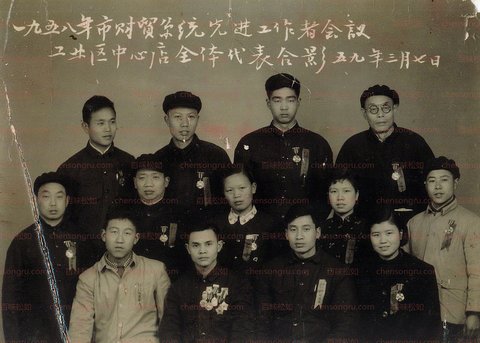
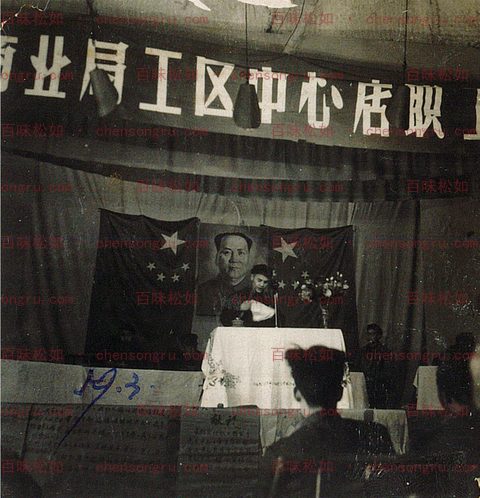
Meanwhile, out of his sight, something was already brewing. According to the biography Songfeng Ruren, during a central work conference in the winter of 1958, several Sichuanese leaders remarked over dinner that “it’s been so long since we’ve tasted authentic hometown flavors” — and Premier Zhou Enlai decided on the spot: open a Sichuan restaurant in Beijing.2 Responsibility for the project fell to Beijing Mayor Peng Zhen and Sichuan Provincial Party Secretary Yan Hongyan — Beijing handling the site and management, Sichuan handling the selection of skilled staff and the supply of ingredients. The site finally chosen was a former Qing-dynasty princely mansion on Xirongxian Alley off XidanBiographical account3. Two additions, August 2026 (from Chen Tinglong’s oral material): the secretary’s name also appears written “Yan Hongyan” in a variant form — the same man; and the standard for selecting the staff sent to Beijing was “both red and expert, politically clean.” This was not recorded here before, and it is a reminder that the 1959 selection was not only about cooking.
Forty-One People Assembled, and One Man’s Farewell
It wasn’t just one man heading to the capital — it was a whole team. But each of them had their own goodbye to say.
Selection began in early 1959, screening candidates layer by layer from Chengdu, Chongqing, Luzhou, Yibin, Leshan and other cities, ultimately assembling forty-one Sichuan-cuisine chefs and service staffBiographical account. The three chefs selected from Chengdu were Chen Songru, Chen Haiqing, and Wang Yuequan — this list is corroborated by Chen Tinglong’s 1988 essayBiographical account(Corroborated by family documents, pending independent verification)4. Chen Songru was designated the convener of the chefs heading to Beijing, and would go on to become the Sichuan Restaurant’s head chef.
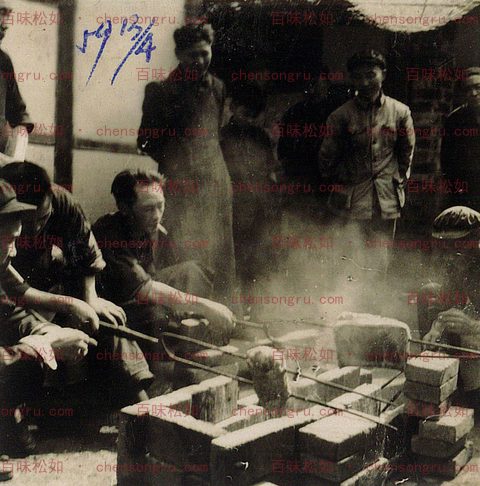
According to the biography, a few days before May Day, a jeep with Beijing plates pulled up at the family’s door. At that moment his wife, Jiang Mingshu, was in the courtyard drying chili peppers; the officials solemnly announced that Chen Songru had been posted to the Sichuan Restaurant in Beijing. The string of chilies in her hand swayed, and a few peppers fell onto the flagstones — and then she smiledBiographical account. Over the preceding years, she had raised three children, run a dry-goods shop, and worked as a laborer on the Chunxi Road reconstruction site — holding up the entire home front by herself.
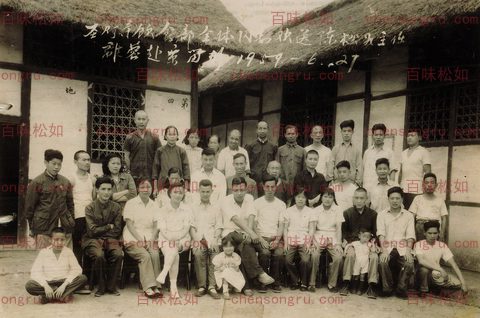
Traveling in the same wave, or shortly after him, to the Beijing Sichuan Restaurant were many other well-known Sichuan chefs, including Huang Shaoqing, Liu Shaokui, Li Xieyao, Chen Jingzhen, Jiang Xiru, and Ni ShuzhangBiographical account. Supplies moved north as a whole system too: Sichuan Province allocated a thousand pigs a year at internal prices, over thirty thousand jin of specialty seasonings such as Sichuan pepper, chili, and doubanjiang, five thousand bottles of grain liquor, and even specialized cookware and more than thirty varieties of flowers were shipped to the capital togetherBiographical account.
A North Wing Beside the Coal Pile, and a Two-Week Renovation
Before the glory began, there was a gap between expectation and reality.
According to the biography, on the night of June 30, 1959, Chen Songru’s group arrived at the site of the Beijing Sichuan Restaurant. What greeted them was not the restaurant they had imagined, but an old princely mansion with peeling paint and cracked walls; their quarters were assigned to a north-facing room next to the coal pile in the east courtyard, and the smell of coal hit them the moment they walked in; their daily staple was corn porridge and steamed corn buns — for chefs from Sichuan used to eating rice, the very first night gave them a taste of just how much weight the phrase “coming to the capital” carriedBiographical account.
Chen Songru honestly reported everyone’s low morale to the restaurant’s leadership. When Marshal Zhu De heard about it, he came to the Sichuan Restaurant in person to encourage the chefs: “Conditions are hard right now, but this is only temporary. If we all pull together, we will make a success of this restaurant.”Biographical account5 In July, in anticipation of possible foreign-guest receptions, Zhu De decreed that “a good restaurant environment is a matter of national dignity” and ordered renovations before opening: the entire courtyard was repainted while everything else was left untouched, and armchairs, sofas, round tables and tablecloths were brought over from the Great Hall of the People’s banquet hall. Within two weeks, the restaurant looked entirely differentBiographical account6.
The restaurant’s name, “Sichuan Restaurant,” was proposed by Sichuanese marshals Zhu De and Chen Yi among others, and personally chosen by Premier Zhou Enlai; the calligrapher Guo Moruo, also from Sichuan, was invited to write the sign board — this history was later written into an official release by the Beijing Xicheng District government on “Beijing’s time-honored brands.”Independent source7
One Table of Dishes, and Four Instructions
The remarks left behind at this test dinner became the restaurant’s operating principles for more than half a century afterward.
On August 4, 1959 (the test-dinner date is also given elsewhere as August 28; see “Gaps in the Record”), the Sichuan Restaurant held its opening test dinner. Attendees included Zhou Enlai, Zhu De, Chen Yi, Deng Xiaoping, Yang Shangkun, He Long, Luo Ruiqing, Zhang Aiping, Guo Moruo, and other leading officialsBiographical account.
After the test dinner, Mayor Peng Zhen received all the chefs and service staff. Several remarks left by the leaders each became a lasting principle:
Beijing has plenty of large restaurants and plenty of regional cuisines. Sichuan food must be prepared strictly according to Sichuan methods, so the dishes don’t lose their character — only by guaranteeing authentic Sichuan flavor can you gain a firm footing here.
You must hold on to Sichuan flavor. Some people have suggested going easy on the chili to suit local tastes — that won’t do! How can you make Twice-Cooked Pork without chili? If you’re not used to Twice-Cooked Pork with chili, you can order Sauce-Fried Pork instead. If anyone tells the chefs to leave out the chili, send them to me.
When Sichuan cuisine comes to Beijing, don’t try to dress it up in some Westernized style — it may look nice but won’t taste right. Sichuan cuisine is about flavor; you have to keep its distinctive Sichuan character.
The restaurant must hold to true, flavorful dishes; plating should be tasteful and generous, not gaudy.
Sharing a Birthday with the Republic
The opening date was set for October 1 — from day one, this was never just a restaurant.
Premier Zhou Enlai set the official opening date as October 1, 1959, to coincide with the People’s Republic’s tenth anniversary, and defined the restaurant’s mandate: “Serve the central government, serve politics, serve the people of the capital” — while specifically requiring that one dining room be reserved for ordinary Beijing residents to enjoy authentic Sichuan foodBiographical account. There were also three standing duties: hosting banquets off-site on a regular basis, regularly assisting with catering at the Great Hall of the People, and supporting banquets at Zhongnanhai and DiaoyutaiBiographical account. Around the tenth-anniversary celebrations, Chen Songru would often lead ten to twenty chefs straight to the Great Hall of the People after wrapping up dinner service at the Sichuan Restaurant, prepare banquets through the night, and return at dawnBiographical account.
For eight consecutive years, from 1959 to 1966, Mayor Peng Zhen held a banquet at the Yangfengjiadao senior cadres’ club on May Day and National Day for the leaders who had watched the parade from Tiananmen Gate — twelve tables each time, Zhou Enlai present on every occasion, Mao Zedong on some. The menu was fixed: home-style minced pork sea cucumber, oil-net lantern chicken, braised ox head, duck breast with soy dregs, mushrooms with greens or steamed cabbage in supreme broth, dry-braised fatty-head fish, milk-broth vegetable stew, dan dan noodles and sweet rice balls. The kitchen asked more than once to change it and was told there was no need — “dishes may be added, but not changed.”Biographical account(family sources cross-checked; independent verification pending)
A menu that did not change for eight years is one concrete form of something this exhibition keeps returning to: “the authentic flavour must not be lost” hardening from spoken instruction into a standing constraint. Note the direction, too: it was the kitchen that wanted to change the menu and the guests who did not — reading the Sichuan Restaurant of those years as merely conservative does not fit this record.
Four Dishes, a Bunch of Grapes, and a Chicken Remade Overnight
The high point of the whole exhibition, and the earliest physical evidence behind the phrase “the dish reflects the character.”
That autumn, Chen Songru was sent into Zhongnanhai for the first time, to cook for Mao Zedong. The exact date is recorded differently in two family documents: this site’s timeline previously followed Chen Tinglong’s document, which gives September 7; the biography Songfeng Ruren, Chapter Six, gives October 7 instead — both are presented honestly side by side; see “Gaps in the Record.”Unverified He was taken there by Deng Zhi, party branch secretary of the Sichuan RestaurantBiographical account8.
During the meal, Mao Zedong had the staff take the grapes set aside for him and “give them to the ‘master chef’ to try”Biographical account. But what was truly remembered was the problem that arose after the meal —
Oil-Net Lantern Chicken
- What happened that day
- Mao Zedong ate half of it and, breaking with usual practice, asked to save the rest for the evening. But this dish depends on a crisp exterior and tender interior — reheating it would ruin the quality. Chen Songru discussed it with Secretary Deng Zhi and decided: he would go back to the restaurant that same night and make it afresh (Chen Songru’s own words were “I made another pair of blanks” — the dish is two birds to a plate, so what he remade was the whole dish, not half of one), frying it up and then presenting it made to look like the amount left over from lunch (the two accounts differ slightly on exactly how much was left at lunch — the memoir says “half,” the biography says “a third” — both are presented honestly). After finishing it, Mao Zedong said, “We mustn’t waste such a delicious dish.”First-hand account9
- Where this dish comes from
- A Sichuan technique dish in which chicken is wrapped in pork caul fat, taking the shape of a lantern. It appeared on the August test-dinner menu and remained on the regular menu long after the opening — in 1959, it was the restaurant’s signature card. It was developed from an older Sichuan dish, oil-net pocket chicken: two slices of chicken breast with a preserved-vegetable and pork filling, wrapped in caul fat and deep-fried — “awkward to slice and plate, and salty-savoury throughout.” The lantern version takes a Beijing spring chicken, smaller than a fryer and larger than a pigeon: two whole birds, one in a five-spice white brine and the other in a red chilli brine, boned, scored, worked by hand into a lantern shape, wrapped in caul fat and fried — one dish of two colours and two flavours.
- Where this dish went
- In 1972, at the Jinniuba Guesthouse, Chen Songru personally taught this dish to his son, Chen Tinglong — one of two signature dishes he passed on by hand. “Legacy isn’t handed down through instructions, but through a single object and a single craft” — Wisdom →
A photograph by the sea — but from which year?
The original caption dates it to 1959; the author of Songfeng Ruren, weighing the clothing and the calendar, finds the summer of 1962 far more plausible.10
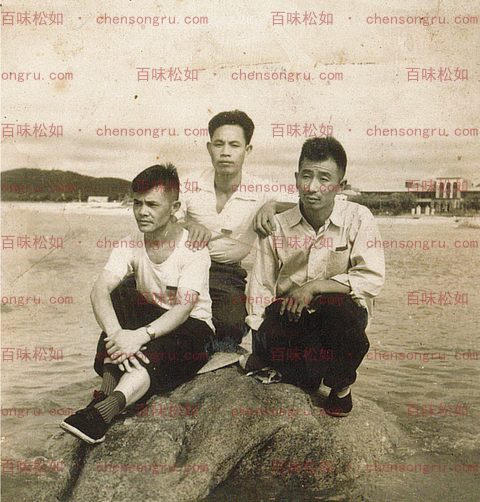
The author of Songfeng Ruren questions the 1959 dating of this photograph: the holiday can hardly have fallen in that year. Three reasons. First, the men wear short-sleeved vests — clearly a summer escape from the heat; yet his first visit to Zhongnanhai came in the autumn of 1959 (September 7 and October 7, two accounts side by side), when summer was already over — a holiday “that same year” does not fit the calendar. Second, 1959–1961 were the three years of hardship, when a seaside holiday would have been out of keeping with the times. Third, on his first visit he was still a newcomer; so generous an arrangement after a single meal would hardly have matched his standing. Working from the surviving menus by which the biography dates his three visits to Zhongnanhai, the most plausible sequence is: after the third visit in August 1961, he taught the Chairman’s cooks for a fourth time with all his heart; the Chairman was deeply moved, and the following year — the summer of 1962 — came the ten-day holiday at Beidaihe. This site keeps the original caption as written, and marks the year as disputed per this re-dating.Unverified
On March 7, he stood for a group photo in Chengdu, an Advanced Worker medal on his chest; by that autumn, he was standing in the kitchens of Zhongnanhai. Within a single year, the director of the Shengdeng Temple branch store had walked into the state-banquet service — and the next three decades of his story all begin from this one year.
The restaurant opened inside a princely mansion
The site was not just any building that happened to be available. No. 51 Xirongxian Hutong is a Qing-dynasty mansion that changed hands several times before it became the Sichuan Restaurant’s address — first a princely residence, then a banker’s private house, then government offices, and only in 1959 a Sichuan restaurant. The place where the kitchen was set up had not seen cooking fires for three hundred years.

Functional layout of the three courtyards, Sichuan Restaurant, Beijing
Facing south. The first courtyard holds the snack counter; the second is an enclosed courtyard with the à la carte dining room at its head, a dining room for foreign guests to the west and another à la carte room to the east; at the north end of the third courtyard is the banquet hall, flanked by three smaller banquet rooms. State banquets and official receptions were mostly held in the third courtyard; ordinary diners came in through the first.
This drawing was made by this site to show how the courtyards were used at the time. It is not a measured survey drawing. This site has not obtained the original plans; the actual dimensions, bay widths, orientation details and successive alterations of the buildings are all unverified (see note 11 on this page).
From Beizi mansion to the Yu Mansion
In the Qing period this was a residence of the beizi rank. Public accounts state that in the eighth year of the Tongzhi reign (1869) it became the residence of Mianxun, a grandson of Yunmi, Prince Xian and the twenty-fourth son of the Kangxi Emperor, and was then known as the Xun Beizi Mansion; in the twenty-eighth year of the Guangxu reign, Mianxun’s great-grandson Puyu inherited the title of Duke of the Realm and the house was renamed the Yu Mansion (Yu Gong Fu). The character 霱, pronounced like 玉 (yù), means an auspicious cloud; it is rare, and is still frequently misread and miswritten11.
One discrepancy should be noted. Within the same body of material, another passage dates the Xun Beizi Mansion vaguely to “the Guangxu reign”, which does not agree with the year given above. Both accounts come from the same kind of source — self-published retellings — so this site sets them side by side without reconciling them.
Changing hands: 1924 and 1950
After the fall of the Qing the household’s stipend ceased. Puyu is said to have sold off family property to make ends meet, and in 1924 sold the entire compound to Zhou Zuomin, general manager of the Kincheng Banking Corporation. In 1950 Zhou donated the house to the state, after which it served for a time as offices of the Ministry of Supervision of the Central People’s Government. When the Sichuan Restaurant was being established in 1959 this site was chosen; Zhou Enlai gave it the name “Sichuan Restaurant” and Guo Moruo wrote the signboard12.
The restaurant itself moved twice more. In the mid-1990s it took up quarters in the Prince Gong Mansion (sources give the year as either 1995 or 1996), and in 2010 it moved again to Xinjiekou, where it remains. In January 2005 it passed, together with the Fangshan and Fengzeyuan restaurants, into the Quanjude group. The courtyard Chen Songru helped fit out in 1959 is no longer the address of the house he built.
The “selling off family property” episode is told online as a story rich in detail (first the trees at the family graves, then the bricks). Such accounts are largely folk retellings with no verifiable archive behind them; this site records only that property was sold to make ends meet, and does not repeat the particulars.
Why this is worth recording
The compound changed identity five times — beizi mansion, ducal mansion, banker’s house, ministry offices, state-banquet restaurant — while its layout stayed essentially unchanged. After 1959 the halls along the central axis held banquets and the side courtyards the kitchens and stores; for more than thirty years after coming to Beijing, these were the courtyards Chen Songru passed through every day. The Thought and Wisdom page on this site records that he “lived for years in one small room at the restaurant” — that room was here.
The building is today occupied by an organisation and is not open to the public. This site has not surveyed it in person; the above is compiled from publicly available material.
What Can’t Yet Be Confirmed? Whose Voice Hasn’t Yet Made It Into the Archive?
This is the section that sets this exhibition apart from a typical memorial display.
Test-dinner date: August 4, or August 28?
Chen Songru’s own memoir records the test-dinner date as August 4; Chen Tinglong’s essay records it as August 28 — a discrepancy of more than three weeks. Both accounts agree on the October 1 official opening. Both dates come from first-hand family-provided materials, and this site presents them side by side without reconciling them.Unverified
First visit to Zhongnanhai: September 7, or October 7?
One document by Chen Tinglong records the first visit to Zhongnanhai as September 7 (the date this site’s timeline previously followed); the biography Songfeng Ruren, Chapter Six, instead gives October 7 — which, if correct, would place the event after the October 1 opening. Both accounts come from family-side materials, and there is currently no third-party record to determine which is correct; both are presented honestly.Unverified
Year of joining the Party: 1957, winter 1958, or March 1959?
A 1993 eulogy from his work unit records “March 1959”; his direct disciple Xiao Jianming’s oral account gives “1957”; and Chapter Five of the biography Songfeng Ruren separately describes his wife, Jiang Mingshu, hearing the news of her husband joining the Party over the radio in the winter of 1958. The three accounts do not agree with one another, and are presented honestly side by side.Unverified
The list of forty-one: who were they?
The biography records that forty-one chefs and service staff were selected from across Sichuan Province to go to Beijing in 1959. The three chefs from Chengdu (Chen Songru, Chen Haiqing, Wang Yuequan) are corroborated by two family documents; the biography also names Huang Shaoqing, Liu Shaokui, Li Xieyao, Chen Jingzhen, Jiang Xiru, and Ni Shuzhang — but a complete list of all forty-one, along with the broader group of service, logistics, and supply-chain staff, remains almost entirely undocumented on this site.
Why does so much material come from family, disciples, and a biography published decades later?
Chen Songru passed away in 1993. The overwhelming majority of first-hand materials on this site — photographs, certificates, manuscripts — were provided by the family as scans in 2026, and oral accounts come mainly from essays written by direct disciples. This means that for many details, the gap between the earliest surviving record and the event itself spans decades — this is precisely a “gap in the record,” not a deliberate concealment.
The core archival items directly related to 1959 can all be viewed on the “Digital Archive” page, with images of the originals and full information cards:
| ID | Title | Date | Evidence Level |
|---|---|---|---|
| MS-001 | Chen Songru’s autobiographical manuscript | 1980s (recording his 1959 experiences) | First-hand account |
| PH-001 | 1959 commemorative photo of chefs selected from Sichuan | 1959 | First-Hand Object |
| PH-006 | March 1959 speech at the district staff representatives’ conference | 1959.3 | First-Hand Object |
| PH-007 | April 1959 preparing char siu chicken at Shengdeng Temple | 1959.4 | First-Hand Object |
| PH-008 | June 1959 farewell group photo at Shengdeng Temple | 1959.6 | First-Hand Object |
| PH-009 | Beidaihe holiday reward group photo | Re-dated: likely summer 1962 | First-Hand Object Unverified(Dating unverified) |
| CE-002 | Beijing Sichuan Restaurant letter of appointment | 1959 | First-Hand Object |
| BK-001 / BK-002 | 160 Authentic Sichuan Dishes / The Sichuan Restaurant Cookbook | 1991 / 1989 | Independent source |
Sichuan Cuisine Is Still Migrating
The flavors that came to Beijing in 1959 later found their way into a 37-page manuscript around 1980, and again onto a banquet table in Singapore in 1987. “Authenticity” is not a frozen standard, but a living tradition that is constantly practiced, tested, and questioned — Sichuan cuisine’s journey to Beijing was never truly finished; it continues still.
Sources
- Independent sourceThe 1993 eulogy written for Chen Songru by the Beijing Sichuan Restaurant (Chengdu Catering Service Company) states plainly: “After the conversion to joint state-private ownership in November 1956, Comrade Chen Songru became manager of the Shengdengsi state-run catering outlet in Chengdu.” This is independent of the other materials supplied by the family.↩
- Biographical accountBiography Songfeng Ruren, chapter 6, section 2: “During the central work conference in the winter of 1958, a Sichuanese participant mentioned to Zhou Enlai how he missed the flavours of home, and Zhou Enlai decided there and then to establish a Sichuan Restaurant.”↩
- Independent sourceDrawn from several independent reports, including “Sichuan Restaurant: Opened 1 October 1959, a Gathering of Master Chefs” on Beijing Tourism Net: the site chosen was a late-Qing princely compound in Xirongxian Lane, Xidan (formerly the Yu Prince’s Mansion); Zhou Enlai named the restaurant himself and Guo Moruo wrote the signboard. All of this is supplementary information independent of the biography and does not conflict with it.↩
- Biographical accountChen Songru’s own A Short History of the Beijing Sichuan Restaurant (first published in Sichuan Cuisine, 1988, no. 9) and the article “Recollections — A Short History of the Beijing Sichuan Restaurant” reprinted on Sohu both record that the cooks selected from Chengdu included Chen Songru, Chen Haiqing and Wang Yuequan. Both texts ultimately derive from Chen Songru himself and from family materials, and still await verification by a third party fully independent of the family circle.↩
- Biographical accountBiography Songfeng Ruren, chapter 6, section 4, in Zhu De’s words: “Conditions are hard just now, but that is temporary. If we pull together we can certainly make a success of the Sichuan Restaurant. Once it is running, our lives will get better too.”↩
- Biographical accountBiography Songfeng Ruren, chapter 6, section 4, in Zhu De’s words: “A restaurant in good order is a matter of the country’s dignity; frugality is no reason to overlook it. Let us repair the premises and get the setting right first, and open for business after that.”↩
- Independent sourceThe official announcement of “Beijing Time-honoured Brand” designations on the website of the Xicheng District People’s Government of Beijing (released 17 July 2024): the Sichuan Restaurant was “founded in 1959 at the suggestion of the Sichuan-born marshals Zhu De and Chen Yi among others, and named personally by Premier Zhou Enlai.”↩
- Biographical accountThe article “Recollections — A Short History of the Beijing Sichuan Restaurant”, reprinted on Sohu, records that Deng Zhi, Party branch secretary of the Sichuan Restaurant, once took Chen Songru into Zhongnanhai to cook for Mao Zedong.↩
- First-hand accountChen Songru’s own A Short History of the Beijing Sichuan Restaurant and biography Songfeng Ruren, chapter 6, section 7: Mao Zedong left part of the oil-net lantern chicken to be eaten in the evening; Chen Songru remade it overnight and sent it out. Mao Zedong’s words were, “A dish this good must not go to waste.”↩
- First-hand accountChen Tinglong’s oral-history manuscript Paolong Chenshi, chapter 2, section 8: “Once it was finally settled that I would go with my father to work at the Beijing Sichuan Restaurant, he made a point of taking me to the Jinniuba guesthouse and teaching me two dishes with his own hands — one was oil-net lantern chicken, the other kaishui baicai.”↩
- DisputedThe lineage of the Yu Mansion (Mianxun’s Xun Beizi Mansion in the eighth year of Tongzhi; Puyu’s inheritance of the ducal title and the renaming in the twenty-eighth year of Guangxu) appears in retellings on Tencent News, Toutiao and WeChat public accounts; no archival or gazetteer source has been found. Within the same material another account dates the title to “the Guangxu reign”, and both readings stand. Listed here for reference, not as established fact.↩
- DisputedThe sale to Zhou Zuomin of the Kincheng Banking Corporation in 1924, the donation to the state in 1950, and the subsequent use as offices of the Ministry of Supervision likewise come from the online articles cited above, with no original archive found. One element — that Zhou Enlai gave the restaurant its name and Guo Moruo wrote the signboard — is separately supported by independent reporting (see note 3 on this page) and is more reliable than the rest of this sequence.↩