
Craft & Legacy
From the tradition of “master-to-apprentice oral instruction, same dish differing from cook to cook” to standardized recipes precise to the gram — Chen Songru was a pivotal force in transforming Sichuan cuisine from folk craft into a state banquet system. Below we present his standardization theory, everyday-ingredient innovations, and representative works.
The Flavor Profile Matrix: Turning “Feel” into “Repeatability”
Evidence strength labels: First-hand account Autobiography or direct disciple testimony · Independent source Third-party media cross-verified · Biographical account Recorded only in biographical manuscripts · Unverified Conflicting accounts in multiple sources · This page contains no physical-evidence tier entries.
To address the problem of Sichuan cuisine’s “master-to-apprentice oral instruction” leading to the same dish tasting different from one chef to another, Chen Songru proposed the “Flavor Profile Matrix” theory: deconstructing Sichuan cuisine’s twenty-four flavor profiles into proportional relationships of base ingredients — salt, sugar, vinegar, chili, etc. — making seasoning quantifiable and replicable. He led the creation of the Sichuan Cuisine Standardization Manual. Biographical account
Mapo Tofu · Standardized Recipe Example
Precise recipes allow different chefs and shifts to produce consistent, stable flavors — a direct embodiment of the decision heuristic: “new tools should serve quality control, not laziness.”
Kung Pao Chicken · Standardized Cooking Time
Introduced timers, meat slicers, and other mechanical aids to standardize the critical elements of heat control and knife work.
The “Umami Trinity”
Stock · Soy sauce · Fish sauce — used to establish a stable, transferable umami base across different dishes. Biographical account
His Core Cooking Principles
Sichuan as the Backbone, Absorbing All Schools
Rooted in Sichuan cuisine while incorporating strengths from other schools to create new-style Sichuan dishes. Examples include the Beijing-Sichuan fusion “Mapo Tofu Braised Sea Cucumber,” and borrowing from Shandong cuisine’s Sweet-and-Sour Carp technique to create “Crispy Sweet-and-Sour Fish,” which later became a state banquet candidate dish.
One Dish, One Character; A Hundred Dishes, A Hundred Flavors
When teaching Chairman Mao’s personal chef the flavor characteristics of Sichuan cuisine: emphasizing the perfect integration of color, aroma, taste, form, and vessel; varied seasoning with diverse dish styles; balancing freshness, clarity, richness, and intensity.
Orthodox Core, Flexible Periphery
Reduced spiciness and added creaminess for Western leaders, designed a curry chicken for Indonesian guests; but refused changes that shook the core — such as “Twice-Cooked Pork without chili” — with Zhu De’s own words providing backup: “You can switch to Sauce-Fried Pork instead. Tell them to talk to me.”
Everyday-Ingredient Substitutions: Bringing “Luxury” Flavors to Ordinary Tables
Using common, affordable ingredients to mimic the texture and appearance of rare ingredients — not to “cheap out fraudulently,” but to let more people enjoy the flavor experience that was once reserved for a privileged few.
Mock Shark Fin Soup
Replaced shark fin with pig brain to simulate its gelatinous texture, allowing ordinary diners to experience the flavor layering of a “luxury dish.”
Vegetarian Bird’s Nest / Vegetarian Eel
Used sweet potato starch to mimic the texture and appearance of bird’s nest and eel, overcoming the cost and seasonal limitations of rare ingredients.
Tofu “Fish”
Designed for a salt merchant’s mother’s birthday feast in 1941, when fish prices were too high — used tofu to replicate the shape and flavor of fish, fooling the guests and providing a dignified finish to the three-day banquet.
He also partnered with a cannery to can Twice-Cooked Pork and Yu-Xiang Shredded Pork, breaking seasonal limits; developed a “dried bamboo shoot rehydration technique” to solve the problem of no fresh bamboo shoots in winter. Biographical account
Over a Thousand Sichuan Dishes Catalogued (from Chen Tinglong’s Preserved Manuscripts)
The manuscripts preserved by Chen Tinglong (Chen Songru’s son) record over a thousand classic Sichuan dishes by category. Below is a partial listing, corresponding to the earlier figures of “over 3,000 / over 1,000 / over 100” — this is the most granular inventory currently available. Second-hand compilation
Bird’s Nest · 5 dishes
Clear Soup Bird’s Nest, Rock Sugar Bird’s Nest, Pigeon Egg Bird’s Nest Soup, Three-Delicacy Bird’s Nest, Rock Sugar Pineapple Bird’s Nest
Shark Fin · 14 dishes
Braised Shark Fin, Wrapped Baked Shark Fin, Three-Shred Shark Fin, Chicken Purée Shark Fin, Assorted-Shred Shark Fin, Buddha’s Hand Shark Fin, Chicken-Shred Shark Fin, Yellow-Braised Shark Fin, Bouquet Shark Fin, Duck-Wrapped Shark Fin, Milk Soup Shark Fin, Prawn-Cutlet Shark Fin, Clear Soup Shark Fin, Crab Roe Shark Fin
Bear Paw · 6 dishes
Yellow-Braised Bear Paw, Sea Cucumber-Braised Bear Paw, Beef Tendon-Braised Bear Paw, Mushroom-Braised Bear Paw, Three-Delicacy-Braised Bear Paw, Abalone-Braised Bear Paw
Sea Cucumber · 40+ dishes
Home-Style Minced Pork Sea Cucumber, Braised Sea Cucumber, Stuffed First-Grade Sea Cucumber, Liver Oil Sea Cucumber, Clear Soup Pickled Cabbage Sea Cucumber, etc.
Abalone · Nearly 30 dishes
Braised Abalone, Chicken-Bell Braised Abalone, Milk Soup Abalone, etc.
Dried Abalone · 20 dishes
Yellow-Braised Dried Abalone, Braised Dried Abalone, Chicken Wing-Braised Dried Abalone, etc.
This list is only a partial excerpt from the manuscripts. Categories such as bird’s nest, shark fin, and bear paw are evidence of how banquet hierarchy was understood at the time. The source is a second-hand compilation; the specific dish counts have not yet been independently verified one by one and are provided for reference only.
These names are catalogued as they appear in the manuscripts, for the study of twentieth-century banquet culture only. This site does not encourage sourcing, consuming, or recreating dishes made from protected wildlife; the conservation and legal status of the species involved varies by region and has changed over time. Chen Songru’s own practice ran the other way: he imitated shark fin with pork brain and bird’s nest with sweet-potato starch so that ordinary diners could taste what had been reserved for a few — see “Affordable substitutes” on this page.
Signature Dishes & Representative Works
Different sources give varying tallies: over his lifetime Chen Songru refined approximately 3,000+ Sichuan dishes (an approximate figure), of which over 1,000 were fully recorded and passed down, and over 100 became the signature dishes of Sichuan Restaurant and state banquet selections. The numerical differences arise from differing counting methods and need not be forced into a single number. How the figures came about, added August 2026 (from Chen Tinglong’s oral material): they were not settled at one stroke but sifted. Everyone contributed the dishes they were best at and the dishes they were expected to know — over three thousand in all; discussion and selection reduced these to over two thousand; refinement and standardisation left four or five hundred fit for a state banquet. State-banquet Sichuan cuisine is the residue of successive siftings, not a list drawn up by any one man. Three additions on technique, August 2026. The house’s signature dishes in its early years were bird’s-nest in clear broth, cabbage in supreme broth, caul-wrapped lantern chicken, duck breast with bean lees, dry-braised shark’s fin, three-yuan abalone, home-style sea cucumber, kung pao prawns and mixed delicacies in milk broth. The restaurant also developed banquets built round a single ingredient — all-chicken, all-duck, all-fish, all-prawn and all-scallop. And the fermented eggs of Xuyong, by convention unsuited to steaming or boiling, he worked into a paste and used in hot dishes and soups — steamed rice-flour pork, stir-fried scallop and shrimp, braised ox pizzle, duck in lees — which his disciple Xiao Jianming called “something of an invention on Master Chen’s part.”
Zhou Enlai’s praise: “Kaishui Baicai (cabbage in a clarified superior broth) is done better at Sichuan Restaurant — you could go there and learn it.” Rose to fame at Pan Wenhua’s birthday banquet in 1938, a quintessential example of “great skill disguised as simplicity.” Multiple contemporary chefs contributed parallel chains in the dish’s state banquet history.
Adapted from “Oil-Net Pouch Chicken” for state banquet requirements, using “Beijing baby spring chicken” — one dish, two colors, two flavors. Chairman Mao once ordered the leftovers kept for a redo the same night.
Created by borrowing from Shandong cuisine’s Sweet-and-Sour Carp technique, later became a state banquet candidate dish — a successful case of “preserving the core while innovating the periphery.”
Refined from the classic Sichuan “Doubanjiang Sea Cucumber.” North Korean Chairman Choe Yong-gon liked it so much that it led to two delegations totaling 32 North Korean chefs coming to China to study. Upon completion, the DPRK awarded Chen Songru a “Thousand-Li Horse Medal” (the year is recorded as either 1962 or 1986 in different sources; both are presented side by side — see “About This Site”).1
Refined from the classic Sichuan “Hodgepodge” (crispy pork skin, deep-fried pork, meatballs — originally considered “unfit for state banquets”) into a dish with multiple steamed pastes in various colors. Chairman Mao tasted it and said, “Excellent! Put it on the state banquet menu.” It thereafter became a state banquet main course and permanent menu item; the state banquet kitchens of Zhongnanhai and the Great Hall of the People both sent teams to Sichuan Restaurant to learn this dish. July 2026 — Newly obtained family materials2
Designed for Indonesian guests’ palates, exemplifying the practical principle of “unchanging orthodox core, flexible peripheral adjustment.”
Deng Xiaoping tasted them multiple times and exclaimed, “I’m eating my hometown’s local specialties again — absolutely wonderful.” Even after recipe standardization, the hometown flavor identity was preserved.
Zhu De’s directive: “If Twice-Cooked Pork can’t have chili, switch to Sauce-Fried Pork instead” — the fallback option when the orthodox core is non-negotiable.
Dishes with names such as “Beacons Blazing Across the Sky,” “Golden Spears and Iron Horses,” and “Triumphant Return,” designed for soldiers departing for the Korean War.
Interactive Teaching · Learn a Dish with the Master
A single-dish teaching toolkit for 16 dishes: technique matrix (ingredient grams + visual proportions), step-by-step follow-along, authenticity self-check (orthodoxy checklist), and ask-the-master (AI Q&A). Historical evidence strength is labeled for each item; where documentation is lacking, it is honestly noted. No fabricated recipes or quotations.
State Banquet Specialties
Praised by Zhou Enlai. 1988 manuscript details the method; two recipe versions presented side by side.
Chairman Mao ordered leftovers kept for an overnight redo. One dish, two colors, two flavors.
Zhu De’s critique + Choe Yong-gon’s visit led to a North Korean study delegation.
1982 state banquet hot dish. Pickled chili is the soul. Authentic manuscript recipe.
Crispy rice hits the plate with a sizzle — signature Sichuan flavor. Authentic manuscript recipe.
Singapore demonstration praised as “a truly unique aroma.” Smoking ingredients proportion visualization.
See the sauce and oil, not the soup. Authentic dry-braised fish manuscript recipe.
Carrot shaped like coral, chicken pieces white as snow. Authentic manuscript recipe.
Zhu De’s directive: “No chili? Not allowed.” The strictest case of orthodoxy criteria.
2 min 30 sec standardized stir-fry time. Both Lychee-flavor and Savory-flavor schools taught.
Standardized recipe and manuscript recipe presented side by side. 1992 public demonstration.
“Excellent, put it on the state banquet menu” — from home-style hodgepodge to state banquet staple.
1941 birthday banquet: fish too expensive, tofu imitated fish to fool the guests.
1984 year-end banquet order slip. Deng Xiaoping’s personal words of praise.
1982 Sihanouk state banquet cold dish. Authentic manuscript recipe.
1987 Zhongnanhai banquet — the decision-making wisdom of an impromptu addition.
Kaishui Baicai (cabbage in a clarified superior broth): Detailed Method
Chicken is the main ingredient for the clear broth, with duck, dried scallops, pork ribs, Yunnan ham, and other ingredients added to enhance umami. Only the tender yellow-white heart of napa cabbage is used, blanched by pouring boiling-hot broth over it from above. “It has the flavor of chicken without seeing the chicken, the flavor of duck without seeing the duck. The broth — pure, elegant, crystal clear. The cabbage — tender green, perfectly formed.” Chen Songru’s original 1988 manuscript
1974 Traditional Grand-Dish Restoration Menu
After Sichuan Restaurant was shut down during the Cultural Revolution and reopened under the name “Chengdu Restaurant” in 1972–73, Chen Songru proactively compiled a list of traditional grand dishes in 1974, restoring them one by one. Chen Songru’s original 1988 manuscript
Three-Delicacy Pot-Sticker, Yellow Wine Duck, Lantern Duck, Dumpling Fish Maw, Dumpling Squid Squares, Longjing Abalone, Longjing Prawn Slices, Soy-Sediment Duck Breast, Preserved Vegetable Stuffed Duck, Grand Stuffed First-Grade Chicken, Oil-Net Crab Meat Roll, Yu-Xiang Oil-Net Prawn Roll, Oil-Net Pouch Chicken, Oil-Net Lantern Chicken, Sichuan Ox Head, Home-Style Minced Pork Sea Cucumber, Chicken Tofu Flower, Kaishui Baicai (cabbage in a clarified superior broth), Clear Soup Liver Cake, Snowflake Walnut Paste, Eight-Treasure Steamed Pot Pudding
Norodom Sihanouk’s 60th Birthday State Banquet Menu
On November 5, 1982, Deng Xiaoping hosted seven tables at Sichuan Restaurant’s North Grand Room to celebrate King Norodom Sihanouk’s 60th birthday. Dual physical evidence — Chen Songru’s original hand-drafted menu and the restaurant’s actual order slip — was formally confirmed in July 2026 by the book Authenticating the Mastery of a Great Chinese Sichuan Chef: Chen Songru. Guests included Deng Xiaoping, Zhao Ziyang, Xi Zhongxun, Yang Dezhi, Huang Hua, and Sihanouk himself along with his daughter and aunt.3
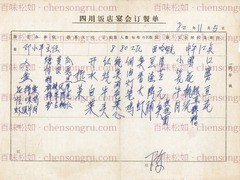
Cold Dishes · Accompaniments (Draft Version)
Panda at Play, Magpies on Plum Blossoms, Pine and Crane in Spring, Eagle Soaring in the Sky, Rooster Heralding Dawn (decorative cold platters); Strange-Flavor Shredded Chicken, Tangerine-Peel Rabbit Cubes, Quick-Fried Cucumber Slices, Yibin Wine-Lees Eggs, Shredded Beef with Sesame, Sugar-Coated Walnuts, Camphor-Tea Smoked Duck Breast, Spicy Phoenix Tail Lettuce
Hot Dishes · Snacks (Draft Version)
Kaishui Baicai (cabbage in a clarified superior broth), Braised Ox Head, Abalone with Two-Color Cabbage Hearts, Oil-Net Lantern Chicken, Soy-Sediment Duck Breast, Yu-Xiang Prawns, Steamed Softshell Turtle, Snowflake Walnut Paste, Mushroom Clear-Broth Tofu Flower; Birthday Peach Buns, Dan Dan Noodles, Steamed Beef in Small Basket, Silver-Ear Fermented Rice Dessert
The restaurant’s actual order slip was slightly simplified (9 cold dishes, 7 hot dishes, 4 snacks), standard 27 yuan/person, 8 tables, 80 guests. Previously circulated online lists of “9 cold dishes + 10 hot dishes + 4 snacks” and scattered 12-item inventories are hereby corrected based on these two physical menus.
Passing Down a Thousand Years of Sichuan Flavors Through the Pen
In the mid-to-late 1980s, Chen Songru grew deeply concerned that “some Sichuan dishes had lost their way in the process of transmission” — certain so-called “Sichuan dishes” were arbitrarily altering cooking methods and seasoning ratios to suit local palates, losing their original character. This was the direct motivation for him to start writing.
Sichuan Restaurant Cookbook 📖
Published January 1989 by Sichuan Science and Technology Press. Organized around spring, summer, autumn, and winter banquet dishes, with detailed records of ingredient ratios, preparation steps, and cost calculations — serving both as a technical guide and a management reference. Known as Sichuan Restaurant’s “martial arts manual.” The first print run was only about 9,000 copies; aside from 50 copies kept by Chen himself, all were given as gifts to banquet guests and never sold commercially. Surviving copies are extremely rare.
Cover →Copyright page →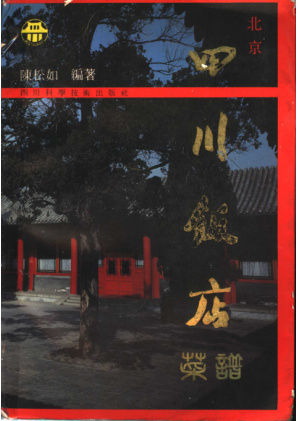
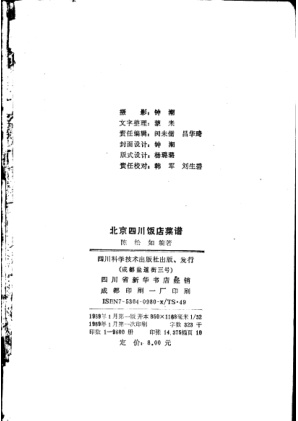
Written authorization from the publisher and family for public digital distribution of the full scanned book has not yet been obtained; only the cover and copyright page are shown here. The full text is not currently available for online reading.
160 Authentic Sichuan Dishes 📖
Published December 1991 by Jindun Press (some editions list the cover as “160 Examples”; internal manuscript terminology is inconsistent — recorded here as is). Focused on popular dishes at accessible prices. Reprinted 17 times. The 160 dishes are divided into seven categories: cold dishes, pork and beef, chicken and duck, fish and shrimp and scallops, mountain delicacies and seafood, vegetarian dishes, and snacks. Illustrated with color finished-dish photos, aimed at families, cooking enthusiasts, professional chefs, and teaching institutions.
Cover →Copyright page →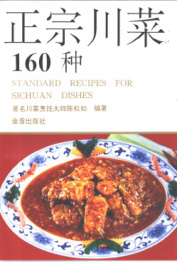
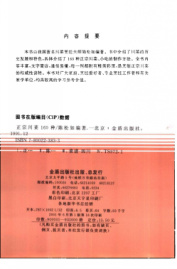
Written authorization from the publisher and family for public digital distribution of the full scanned book has not yet been obtained; only the cover and copyright page are shown here. The full text is not currently available for online reading.
Glossary of Sichuan Culinary Terms
For consistency across language versions, below is a Chinese-English glossary of the core Sichuan-cuisine terms used on this site, for reference in citation and translation.
| Chinese Term | Pinyin | English Translation | Note |
|---|---|---|---|
| 味型 | wèixíng | flavor profile | A system of flavor-profile categories in Sichuan cuisine defined by compound seasoning; traditionally called the “24 flavor profiles” |
| 荔枝味 | lìzhī wèi | lychee flavor | A compound flavor dominated by sour and sweet, named for its resemblance to the taste of lychee |
| 咸香味 | xiánxiāng wèi | salty-savory flavor | A compound flavor dominated by savory, salty, and dry-fragrant notes |
| 怪味 | guàiwèi | strange flavor | A compound flavor balancing six tastes: salty, sweet, sour, spicy, numbing, and savory |
| 鱼香味 | yúxiāng wèi | yu-xiang (fish-fragrant) flavor | Made with pickled chili, ginger, garlic, and sweet-and-sour seasoning; named after a traditional fish-cooking method, not for containing fish |
| 家常味 | jiācháng wèi | home-style flavor | A compound flavor dominated by doubanjiang (fermented broad bean chili paste), savory with mild heat |
| 挂糊 | guà hú | batter-coating | Coating an ingredient in a thin batter before cooking, used to seal in juices or hold its shape |
| 走油 | zǒu yóu | oil-searing | A technique of first deep-frying an ingredient at high heat to set its shape before further cooking |
| 码味 | mǎ wèi | pre-seasoning | Marinating an ingredient in seasonings before cooking so it absorbs flavor in advance |
| 勾芡 | gōu qiàn | starch-thickening | Using a water-starch mixture to thicken a sauce and coat the ingredients |
| 小炒 | xiǎo chǎo | quick-fry | A quick-fry method over high heat for a short time, requiring precise control of heat |
| 正宗内核 | zhèngzōng nèihé | authenticity core | A term used on this site for the non-negotiable defining criterion of a dish (such as a specific main ingredient or step) |
The translations above follow the current usage across this site’s 8 language versions. Some terms have other common translations in Sichuan-cuisine research literature; these are noted honestly and not presented as the sole standard.
Sources
- Biographical accountBiography Songfeng Ruren, chapter 8, section 3: after tasting home-style minced pork sea cucumber, DPRK Chairman Choe Yong-gon remarked, “Korea has plenty of sea cucumber, yet we cannot make it taste this good! … I hope we may send people to learn.” Two study groups totalling thirty-two Korean cooks subsequently came to China. The year of the Chollima decoration is given variously as 1962 and 1986; both accounts are presented here as they stand.↩
- Family material, acquired July 2026According to family material acquired in July 2026: qingtang hunhui was developed from the old Sichuan dish “assorted stew” (pork rind, crisp-fried pork, meatballs — originally “not fit for a state banquet”) into a steamed dish of several coloured pastes. Having tasted it, Mao Zedong said, “Very good! Fit for a state banquet, then.” It thereafter became a main course and a standing item at state banquets.↩
- Primary objectAuthentic Exposition of the Craft of a Chinese Sichuan Master: Chen Songru reproduces both Chen Songru’s handwritten draft Menu for Sihanouk’s Sixtieth Birthday and the Sichuan Restaurant Banquet Order Form actually used by the restaurant. The two documents bear the same date (5 November 1982), establishing that “Sihanouk’s sixtieth birthday” and “the banquet of 5 November 1982” are one and the same occasion; the fragmentary lists circulating online are corrected accordingly.↩