
1982: One Banquet, Two Menus
At noon on 5 November 1982, Deng Xiaoping hosted a banquet in the Great North Room of the Sichuan Restaurant in Beijing to celebrate Prince Norodom Sihanouk’s sixtieth birthday. The occasion left behind two kinds of paper. One is the draft menu Chen Songru wrote in fountain pen on the restaurant’s red-headed letter paper, recording who the guests were and the names of the five sculpted cold platters. The other is the restaurant’s banquet order-form stub, recording how many tables, how many guests, the price per head and who handled the booking. One is the head chef’s plan; the other is the restaurant’s execution. This exhibition publishes both drafts in full for the first time and reads them dish by dish against the order form — which dishes agree, which were renamed, and which appear on only one side.
Two Remarks After the Banquet: What They Said About This Meal
Evidence legend: First-hand account Autobiography or direct disciple testimony · First-Hand Object Original photograph/certificate preserved by the family · Independent source Third-party media cross-verification · Biographical account Found only in biographical manuscripts · Unverified Conflicting accounts across sources
◈ “The taste of home, at its very best!”
What Deng Xiaoping said when he finished this birthday banquet, together with another remark he made on his way out — “Today I finally had doufuhua” — is recorded in Chen Songru’s own autobiography. These are the two most direct first-hand reactions to this banquet that this site currently has on record.
Both remarks come from Chen Songru’s own manuscripts, not from anyone else’s retelling.First-hand1
Three sheets and a stub
The exhibition shows three objects in four images. The first two are menus drafted by Chen Songru himself on “Beijing Sichuan Restaurant” letter paper. Their content is largely the same, but the handwriting and pagination differ; by completeness we call them Draft A and Draft B. The third is the restaurant’s Sichuan Restaurant Banquet Order Form stub. All three have been kept by the family to this day. Original object2
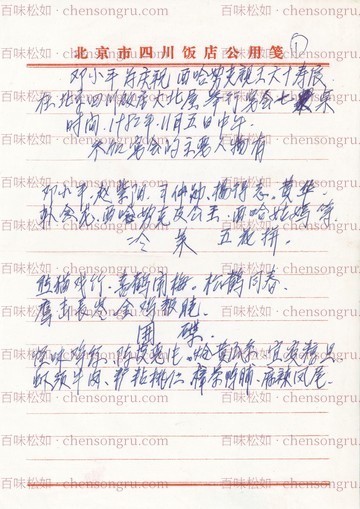
A neat hand, numbered ①
Title, time, guest list, the five sculpted platters and the eight small cold dishes — it stops at the cold course. The circled “①” at top right shows the original ran to more than one page; the family has provided this page only.
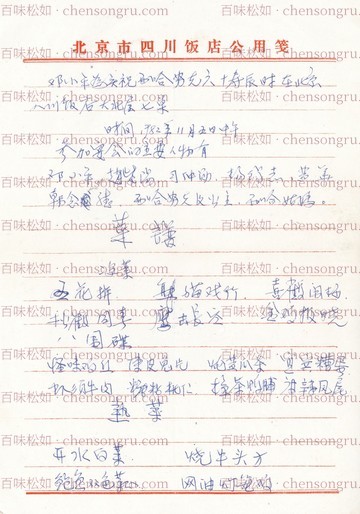
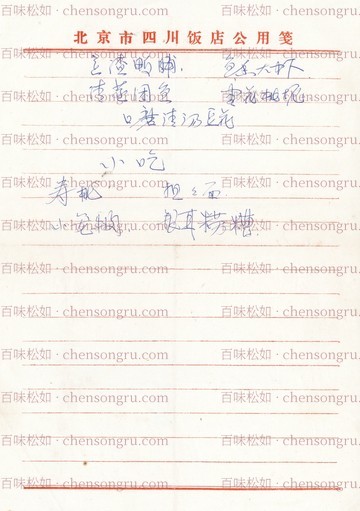
A quicker hand, the full banquet
The same title and guests, with “菜谱” (menu) written large in the middle, running from the cold course and the eight small plates through the hot dishes, soup and snacks. It is the only complete draft menu known so far.
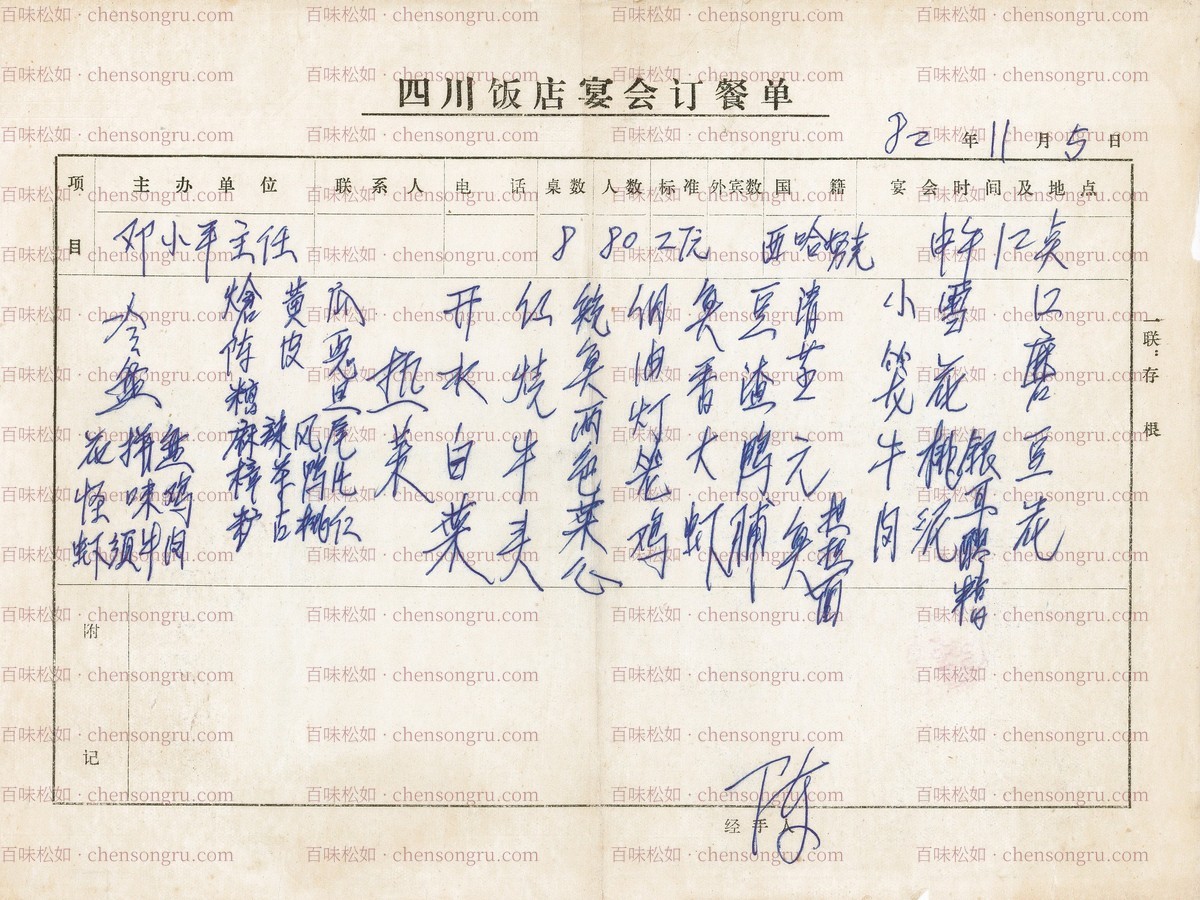
The restaurant’s working copy
A printed form with “一联:存根” (copy 1: stub) at the right edge. Date “82年11月5日” (5 Nov ’82); host “邓小平主任” (Chairman Deng Xiaoping); tables, guests, price, nationality and time filled in column by column; dish names written in the lower half; and a single character, “陈” (Chen), in the handler’s box.
The two drafts and the order form carry exactly the same date. Together they confirm that “Sihanouk’s sixtieth-birthday banquet” and “the banquet of 5 November 1982” are one and the same — a point this site has already settled on the Life & Times → page. What this exhibition wants to see is something else: how the same meal looks different in the head chef’s draft and on the restaurant’s paperwork.
Images are only scaled and watermarked; nothing is retouched or enhanced. One of the drafts was previously reproduced in the published Zhongguo Chuancai Dashi Jiyi Quanzhen: Chen Songru, vol. 13; what is shown here are scans of the originals held by the family.
These drafts were not settled by him alone: according to biographical accounts, Liu Shaokui, the head chef of the stove station at the time, worked out the menu together with Chen Songru — one of the core figures in the kitchen’s technical hierarchy on a par with him at the time.Biographical account4
The day itself
Prince Sihanouk was born on 31 October 1922, so 31 October 1982 was his sixtieth birthday5. The banquet was held not on the day itself but five days later. The host box on the order form reads “邓小平主任” — Chairman Deng Xiaoping. That September, at the First Plenary Session of the 12th Central Committee, Deng had been elected Chairman of the Central Advisory Commission, and the restaurant’s paperwork used exactly that new title.
Set the two “headers” side by side. The draft records who is coming and where; the order form records how many tables, what it costs and who handled it. The head chef and the front desk each wrote down only what they needed.
| Item | Draft menus (A & B) | Order-form stub |
|---|---|---|
| Date | 1982年11月五日中午 (noon, 5 Nov 1982) | 82年11月5日 (5 Nov ’82) |
| Time | noon | 12 noon |
| Venue | Great North Room, Beijing Sichuan Restaurant | not given |
| Host | Deng Xiaoping | Chairman Deng Xiaoping |
| Size | seven tables | 8 tables, 80 guests |
| Price | not given | 27 yuan |
| Guests | Deng Xiaoping, Zhao Ziyang, Xi Zhongxun, Yang Dezhi, Huang Hua, Han Nianlong, Sihanouk and the princess, “Aunt Sihanouk”, and others | nationality box reads “西哈努克” (Sihanouk) |
| Handled by | unsigned | “陈” (Chen) in the handler’s box |
Transcription note
The guest list follows the order of the originals. The sixth name is hastily written in both drafts; this site reads it from the letterforms as “Han Nianlong”6 The published Zhongguo Chuancai Dashi Jiyi Quanzhen: Chen Songru transcribes the same name as “Piao Huilong”, which on verification proves to be an error in that book. The wording “西哈努克及公主” (Sihanouk and the princess) and “西哈姑妈” (Aunt Sihanouk) is transcribed as written, without inference. The “陈” in the order form’s handler box is not necessarily Chen Songru’s own signature; we do not assert that it is.
Five sculpted platters, one line: “flower platter”
Both drafts open the cold course with “五花拼” (five flower platters) and then name each of the five sculpted cold platters in turn. They were the dishes at this birthday banquet that demanded the most craft — and carried the most auspicious meaning.
On the order form, the five names shrink to two characters: “花拼” (flower platter). For the front desk, the flower platter was one cold dish on one line; for the kitchen, it was five sculptures to be designed, carved and assembled days in advance. The same dish carries entirely different weight on the two sheets — which is exactly why reading them side by side matters.
The English under each name is our translation of the dish title; it is not in the original.
Dish by dish
The table below takes Draft B (the only complete copy) as its baseline and follows its order, draft on the left and order form on the right. Draft A stops after the cold course and its dish names match Draft B, so it is not listed separately. Rows with a light red background are dishes written differently on the two sheets, or found on only one of them.
| Course | Chen Songru’s draft (Draft B) | Restaurant order-form stub |
|---|---|---|
| Cold course | ||
| Flower platter | 五花拼:熊猫戏竹 · 喜鹊闹梅 · 松鹤同春 · 鹰击长空 · 金鸡报晓five sculpted platters, each named | 花拼flower platter |
| Eight small cold plates | ||
| Plate 1 | 怪味鸡丝strange-flavor shredded chicken | 怪味鸡strange-flavor chicken |
| Plate 2 | 陈皮兔丁diced rabbit with tangerine peel | 陈皮兔rabbit with tangerine peel |
| Plate 3 | 炝黄瓜条cucumber batons, flash-seasoned | 炝黄瓜cucumber, flash-seasoned |
| Plate 4 | 宜宾糟蛋Yibin wine-lees eggs | 糟蛋wine-lees eggs |
| Plate 5 | 虾须牛肉“shrimp-whisker” beef | 虾须牛肉 |
| Plate 6 | 糖粘桃仁sugar-glazed walnuts | 糖粘桃仁 |
| Plate 7 | 樟茶鸭脯camphor-tea smoked duck breast | 樟茶鸭片camphor-tea smoked duck, sliced |
| Plate 8 | 麻辣凤尾numbing-hot lettuce tips | 麻辣凤尾 |
| Hot dishes | ||
| Hot 1 | 开水白菜cabbage in clear superior broth | 开水白菜 |
| Hot 2 | 烧牛头方braised ox-head squares | 红烧牛头red-braised ox head |
| Hot 3 | 鲍鱼双色菜心abalone with two-color greens | 鲍鱼两色菜心same dish, “two-color” worded differently |
| Hot 4 | 网油灯笼鸡oil-net lantern chicken | 网油灯笼鸡 |
| Hot 5 | 豆渣鸭脯duck breast with bean curd lees | 豆渣鸭脯listed after the yu-xiang prawns |
| Hot 6 | 鱼香大虾yu-xiang prawns | 鱼香大虾 |
| Hot 7 | 清蒸团鱼steamed soft-shell turtle | 清蒸元鱼steamed soft-shell turtle (another name) |
| Sweet | 雪花桃泥“snowflake” walnut paste | 雪花桃泥 |
| Soup | 口蘑清汤豆花tofu pudding in clear broth with mushrooms | 口蘑豆花tofu pudding with mushrooms |
| Snacks | ||
| Snack 1 | 寿桃longevity peach buns | not found |
| Snack 2 | 担担面dan dan noodles | 担担面 |
| Snack 3 | 小笼牛肉small-steamer beef | 小笼牛肉 |
| Snack 4 | 银耳醪糟silver-ear fungus in sweet rice wine | 银耳醪糟 |
Written differently on the two sheets, or found on only one
Transcription note
All three are quick fountain-pen writing, and a few characters have to be read from context: the “丁” of 陈皮兔丁 and the “粘” of 糖粘桃仁 on the order form are not clearly formed, so we keep the site’s existing readings; the order form abbreviates “蛋” (egg) as “旦”, normalized here to “蛋”. The course labels (Plate 1, Hot 1 …) are ours; the originals divide only into cold dishes, eight small plates, hot dishes and snacks, and in Draft B the walnut paste and the tofu-pudding soup follow straight on from the hot dishes. An earlier transcription on the Chinese and Japanese versions of the Craft page read 喜鹤闹梅, 宜宾糖蛋 and 口蘑奶汤豆花; checked character by character against the originals, these are corrected to 喜鹊闹梅, 宜宾糟蛋 and 口蘑清汤豆花.
Where they disagree
Laid over each other, the two records disagree in five places. We set out the differences; wherever the paper gives no reason, we do not supply one.
- Seven tables or eight? Both drafts say “seven tables”, and in Draft A there is a correction right after the character for “seven”; the order form says “8 tables, 80 guests”. Neither sheet explains the extra table, so both are shown as they are. Disputed
- Five names, two characters. The draft’s “five flower platters”, with their five sculpted names, are merged on the order form into a single line, “flower platter”. The dish did not change; the level of detail in the bookkeeping did.
- 团鱼 and 元鱼. The draft has “清蒸团鱼”, the order form “清蒸元鱼”. Both 团鱼 and 元鱼 are names for the soft-shell turtle: the first is common in the spoken usage of Sichuan, Chongqing and elsewhere in the south, the second a spelling often seen on northern menus. The same dish went by two names in the Sichuan head chef’s hand and on a Beijing restaurant’s form.
- The draft is detailed; the form is brief. Shredded strange-flavor chicken → strange-flavor chicken, cucumber batons → cucumber, Yibin wine-lees eggs → wine-lees eggs, tofu pudding in clear broth → tofu pudding: the draft specifies the cut, the place of origin and the broth; the form keeps only the core of the dish. Ox-head squares → red-braised ox head, 双色 → 两色 (“two-color”), duck breast → sliced duck are different wordings for the same dish.
- The longevity peaches are missing. The first snack in Draft B is “寿桃”, longevity peach buns — the most fitting sweet of all for a birthday banquet. There is no such line in the order form’s snack section. Whether they were dropped at the last minute or arranged separately without being written onto the form, the paper does not say. Disputed
This is a clue from outside the paper. The numbing-hot lettuce tips match, character for character, a small cold plate on both drafts and the order form; the “yu-xiang duck squares”, however, appear on none of them. The menus do have “yu-xiang prawns” and “duck breast with bean curd lees”, and we judge that the two dish names crossed in memory. It is the first time this site has been able to set an eyewitness’s memory directly against the archival objects — and a reminder that objects can correct memory, but cannot correct a witness on his behalf. Zhou Shengping’s account also included two details that appear on no piece of paper: security checks were in place that day; and he recalled that the occasion was “Deng Xiaoping hosting a birthday for Sihanouk” — independently corroborating the “sixtieth-birthday” framing, which until now rested on the single mention in the title of Chen Songru’s own handwritten menu, “to celebrate Prince Sihanouk’s sixtieth birthday.”First-hand7
The dishes are still here
Six dishes on this menu already have their own recipe pages on this site: methods, manuscript sources, and differing versions of the recipe side by side. From a draft written more than forty years ago, you can walk all the way to today’s stove.
The six-way compound “strange flavor”; the 37-page manuscript gives the standard recipe.
The draft says “breast”; the order form says “sliced”.
Both menus put it at the head of the hot dishes.
The lantern chicken remade overnight at Zhongnanhai in 1959 was back on the table for this birthday twenty-three years later.
One half of Zhou Shengping’s remembered “yu-xiang duck squares”.
A state banquet still ends with a bowl of street noodles — biographical records say it was cooked personally by Chef Chen Jingzhen.
Object-level rights statement
- Ownership of the originals: the family
- Digitization and metadata: produced by this site (the Baiwei Songru digital archive project), a non-profit personal project; catalogue numbers Digital Archive MS-002 (draft menus A and B) and MS-007 (order-form stub)
- Standardized rights statement: In Copyright (rightsstatements.org InC/1.0)
- Permitted use: images on this site are for remembrance and research viewing and citation only; republication, publication or any commercial use requires separate written permission from the family. This site does not exercise or sublicense that right on the family’s behalf.
Sources
- First-handChen Songru’s autobiography records that after the banquet Deng Xiaoping said, “The taste of home, at its very best!”, and as he walked out into the courtyard added, “Today I finally had doufuhua.” Sihanouk’s own response, “Today’s food was excellent — I ate until my stomach was round,” appears in Chen Songru’s handwritten memoir of 1988. Both quotations come from his own manuscripts, not from anyone else’s retelling. ↩
- Original objectChen Songru’s handwritten draft menus, Draft A (1 page) and Draft B (2 pages), and the Sichuan Restaurant Banquet Order Form stub (1 sheet) — all originals held by the family, provided to this site for checking in August 2026; the family agreed in September 2026 to publish both drafts in full. The order-form stub had already been published on this site. ↩
- Independent sourceZhongguo Chuancai Dashi Jiyi Quanzhen: Chen Songru, vol. 1 (Sichuan Literature and Art Publishing House, 2025) reproduces Chen Songru’s handwritten draft of the Sihanouk sixtieth-birthday menu, whose title reads “To celebrate the sixtieth birthday of Prince Sihanouk, Deng Xiaoping … holds a banquet of seven tables”, consistent with the family’s originals. ↩
- Biographical accountLiu Zihua’s Guoyan Dachu Shuo Chuancai (National Banquet Chefs on Sichuan Cuisine) records that Liu Shaokui, the head chef of the stove station at the time, worked out this banquet’s menu together with Chen Songru; another book by the same author, Chuancai Da Jiangtang (The Great Lecture Hall of Sichuan Cuisine), records that the dan dan noodles served at the banquet were cooked personally by Chef Chen Jingzhen. ↩
- Independent sourceNorodom Sihanouk was born on 31 October 1922, as recorded in standard published biographies and reference works; Deng Xiaoping’s election as Chairman of the Central Advisory Commission at the First Plenary Session of the 12th CPC Central Committee in September 1982 is likewise a matter of public record. ↩
- Independent sourceThe sixth name on the guest list has been verified as Han Nianlong (1910–2000), a native of Renhuai, Guizhou. He joined the revolution in his early years and rose through command positions in the New Fourth Army and the East China Field Army; after 1949 he moved into the Ministry of Foreign Affairs, serving as Ambassador to Pakistan (1951–1956), Ambassador to Sweden (1956–1958), and Executive Vice Foreign Minister in charge of Asian affairs (1964–1982); from 1983 he served as President of the Chinese People’s Institute of Foreign Affairs. His biographical details are confirmed by authoritative material on the Ministry of Foreign Affairs’ official website. Zhongguo Chuancai Dashi Jiyi Quanzhen: Chen Songru transcribes the same name as “Piao Huilong”, which on verification proves to be an error in that book. ↩
- First-handOral account of accompanying cook Zhou Shengping (compiled August 2026); see the 1982 entry on this site’s Life & Times page. The judgment that “yu-xiang duck squares” is a crossing of memories is this site’s, based on the menus themselves; it is not a correction made by Zhou Shengping. If he later confirms the dish name, the entry will be updated. ↩
Between two sheets of paper
The draft names five sculpted platters; the order form has only the two characters for “flower platter”. The draft has longevity peaches; the order form does not. Between the two sheets lies all of a head chef’s work from plan to table — the knife work, the heat and the last-minute adjustments that were never written down, and stayed on that day’s stoves.