
37 Pages: The Sichuan Cuisine He Wrote by Hand
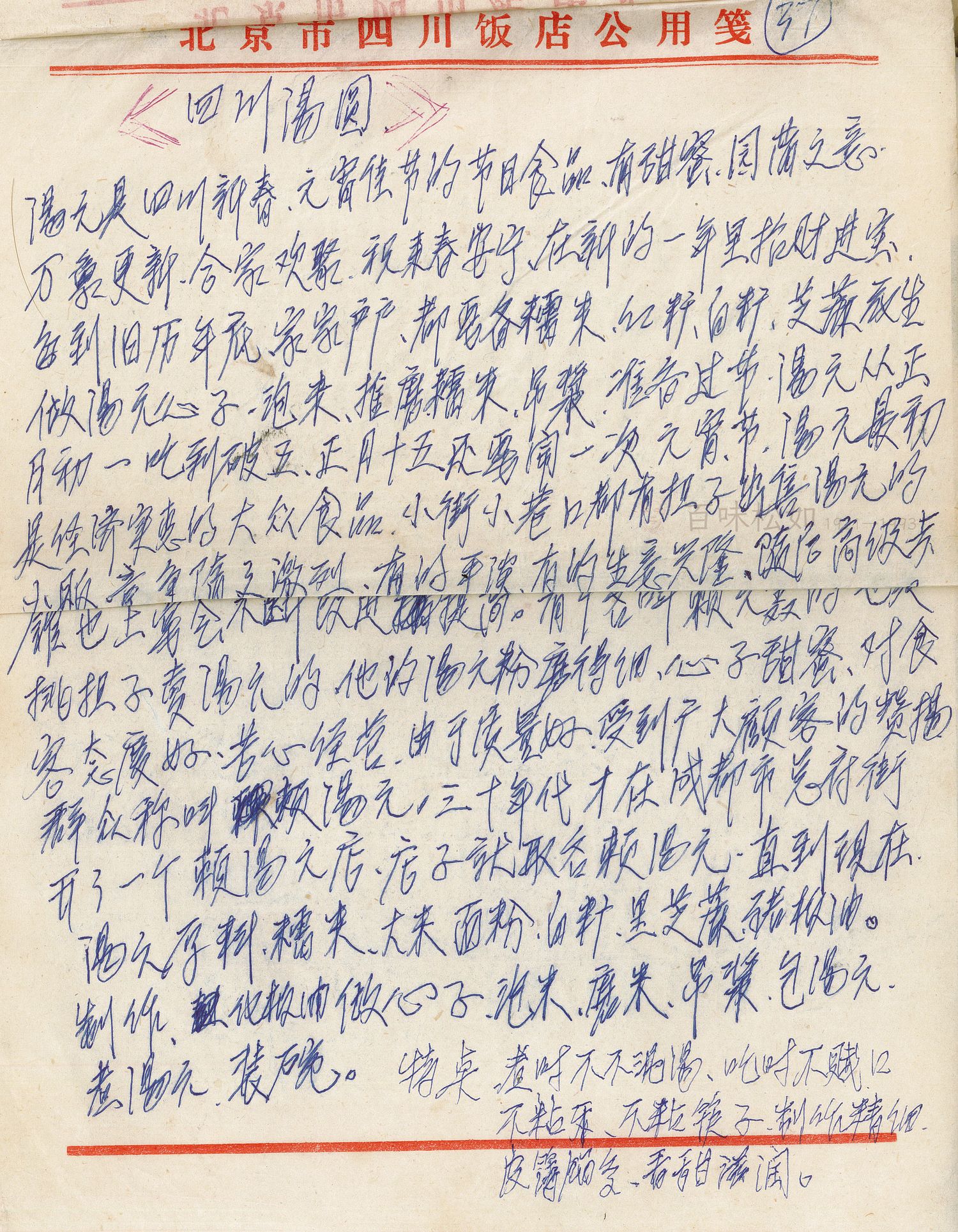
A chef who spent his whole life standing at the stove sat down in his later years and, in pen, filled 37 pages of letterhead paper with “The History and Characteristics of Sichuan Cuisine.” He wrote from the origins in ancient Ba and Shu to the four categories of dishes, from the five defining traits to “eleven hot-dish flavor profiles and twelve cold-dish flavor profiles,” and then set down, one dish at a time, the histories and methods behind famous dishes like mapo tofu and Lai’s tangyuan. This is not a memoir — it is a craftsman writing the biography of his own cuisine. This exhibition presents the complete 37-page fair copy in digital form for the first time.
The Story of a Stack of Letterhead
Evidence legend: First-hand account Autobiography or direct disciple testimony · First-Hand Object Original photograph/certificate preserved by the family · Independent source Third-party media cross-verification · Biographical account Found only in biographical manuscripts · Unverified Conflicting accounts across sources
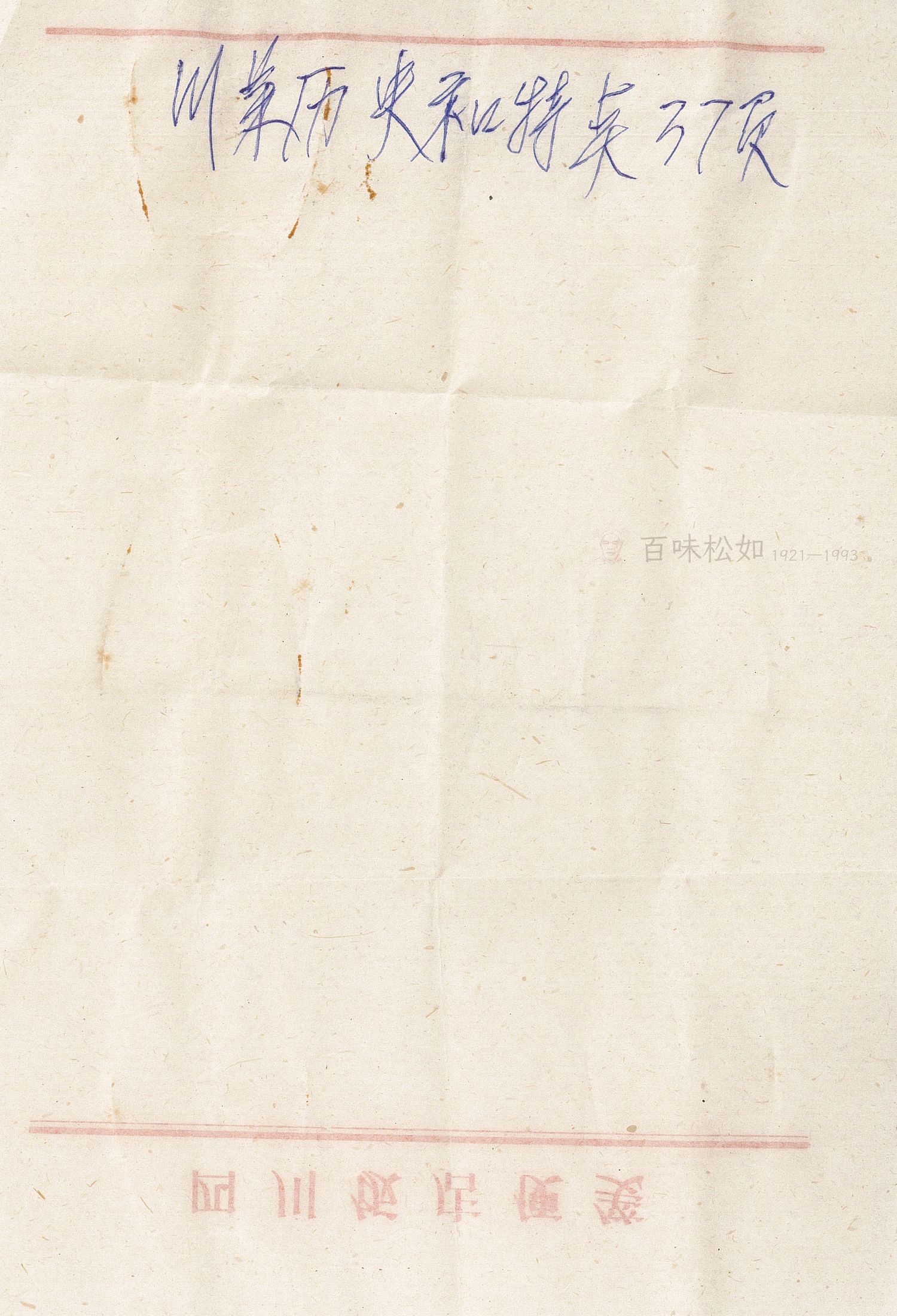
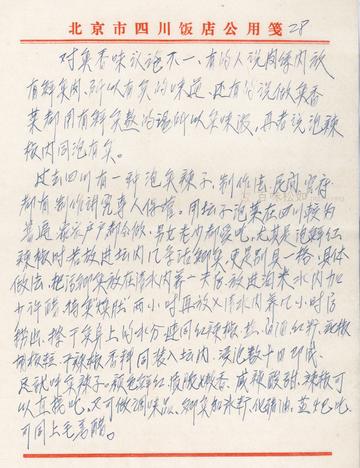
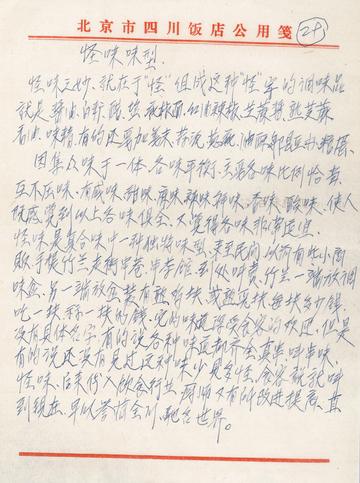
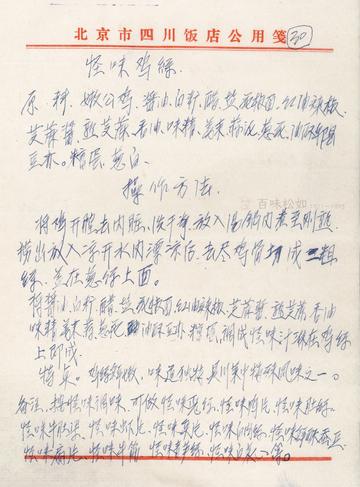
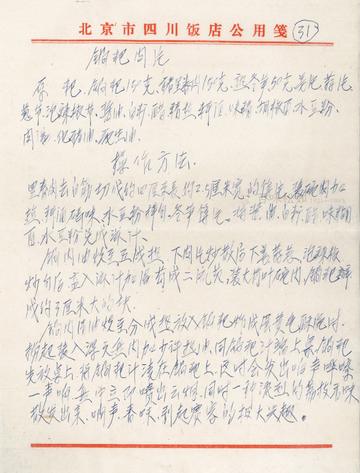
The cover is a sheet of “Sichuan Restaurant” notepaper, on which he wrote seven characters and a number in pen: “History and Characteristics of Sichuan Cuisine, 37 Pages.” Behind the cover, the main text — pages ① through ㊲ — is copied out in neat, well-organized paragraphs on “Beijing Sichuan Restaurant” letterhead: a finished fair copy.
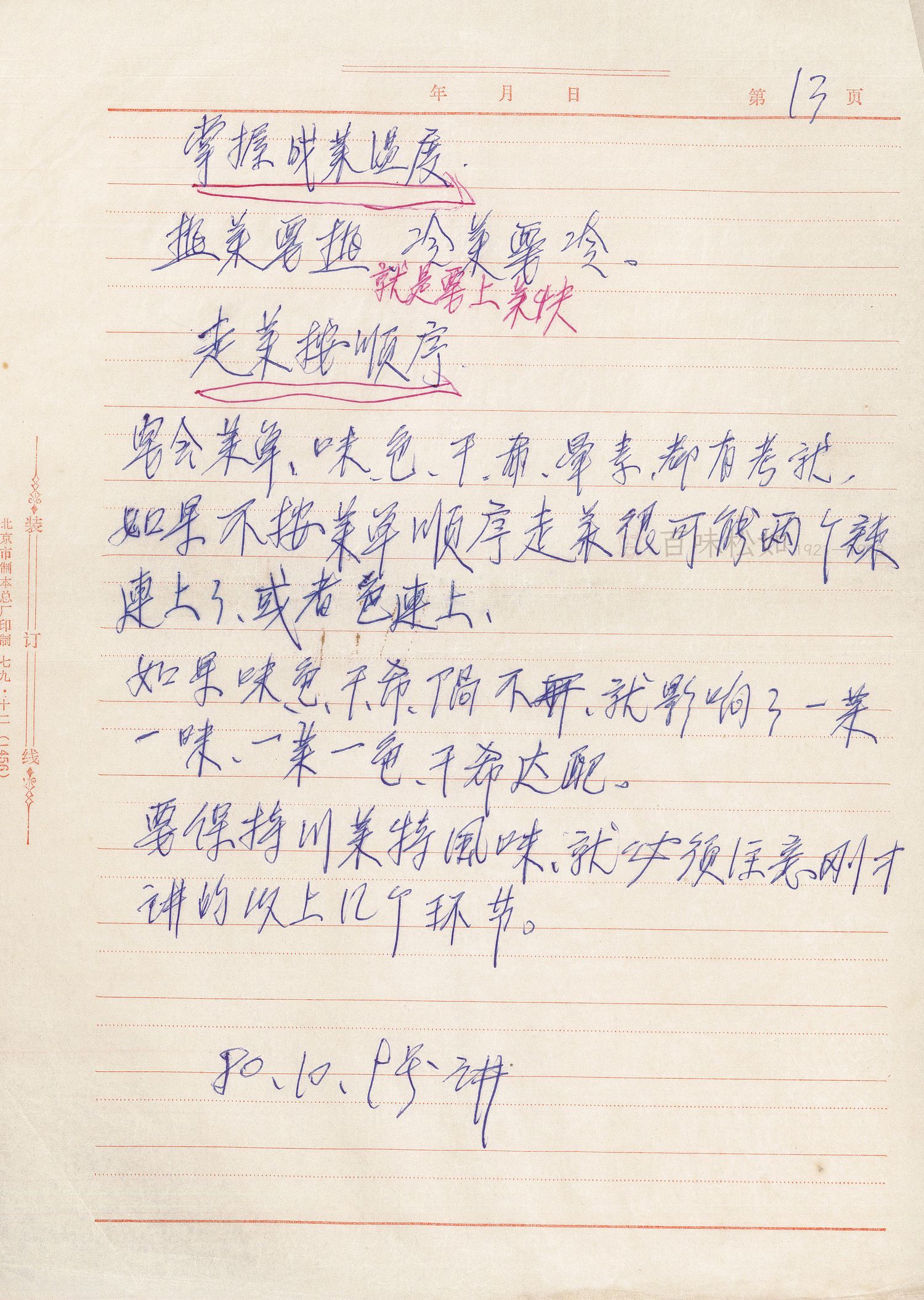
The manuscript has been kept by his family to this day. After a high-resolution scan (2886×4232 pixels), it is published here in full for the first time in August 2026 — to keep load times reasonable, the copies displayed on the site are compressed to 1500 pixels wide; researchers who need the full-resolution preservation master for citation purposes can request it by emailing info@chensongru.com. Kept alongside the fair copy is a bound notebook of drafts and lecture notes (see Unit 06), one page of which is signed and dated “Lectured 10.28.80” with red-pen annotations in his own hand — proof that this treatise wasn’t just written down, but actually used to teach. First-Hand Object1
The page images have only been uniformly scaled and watermarked, with no retouching or enhancement — the paper’s creases, rust stains, and slips of the pen are preserved as they are.
From Ba-Shu to the Whole Country
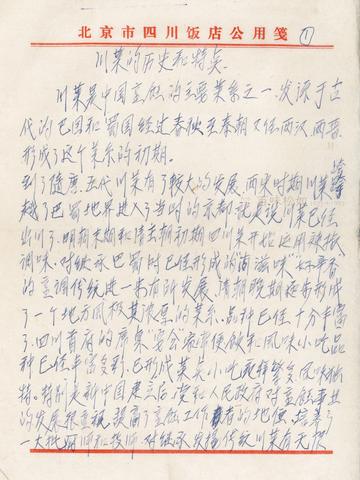
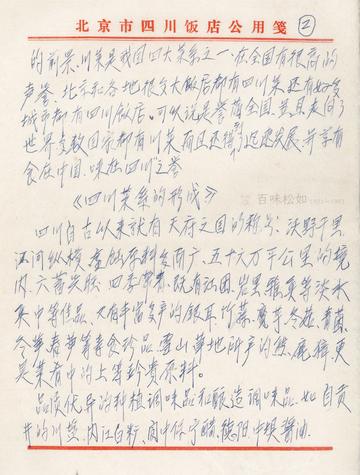
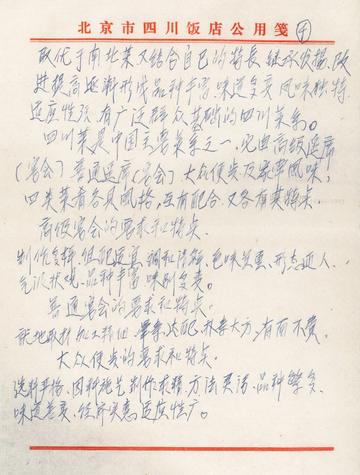
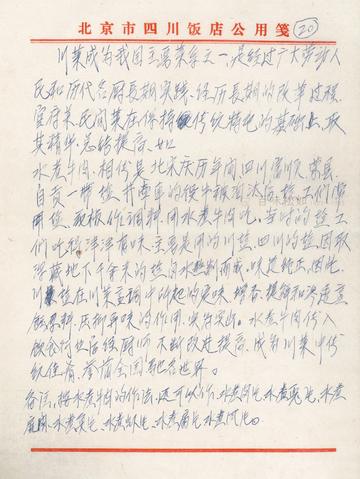
In the opening three pages, he first wrote a minimal general history of Sichuan cuisine: its origin in the ancient states of Ba and Shu; its early formation from the Spring and Autumn period through the Qin, Han, and Jin dynasties; substantial development during the Sui, Tang, and Five Dynasties periods; its move out of Sichuan into the capital during the Song; the adoption of chili as a seasoning in the late Ming and early Qing, continuing the old tradition of “valuing flavor” and “favoring pungent aromatics”; and, by the late Qing, the formation of a cuisine with a strongly regional character. His pen then turns to the “Land of Abundance’s” register of local produce — jiangtuan fish, rock carp, ya fish, Zigong well salt, Neijiang white sugar, Baoning vinegar, Pixian bean paste, Hanyuan peppercorns — laying out, item by item, the material foundation of Sichuan flavor.
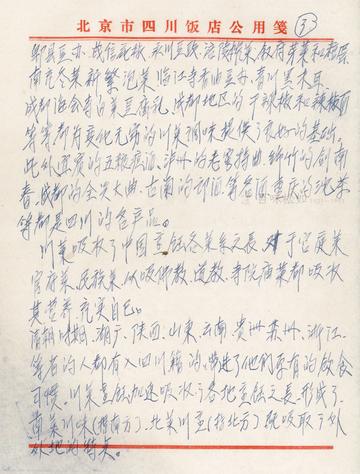
Four characters summarize a whole history of migration: the northern and southern food customs brought by the “Huguang Fills Sichuan” resettlements were re-digested by this land, in its own flavor profiles and heat control. He also writes specifically about how Sichuan cuisine absorbed the strengths of court cuisine, official cuisine, ethnic-minority cuisine, and Buddhist/Daoist temple cuisine — “inclusiveness” is not today’s marketing language; in his account it is the core mechanism by which Sichuan cuisine took shape.
The Order of the Four Categories
Having finished the history, he set out to give Sichuan cuisine its “rules”: all Sichuan dishes fall into four categories, each with its own standard, each with its own logic —
- High-end banquet dishes: complex preparation, well-matched components, harmonious and clean flavor, equal weight on color and taste, captivating presentation, grand and impressive
- Standard banquet dishes: locally sourced ingredients, refined technique, a balance of meat and vegetables, simple and generous, substantial without being expensive
- Everyday meal dishes: strict ingredient selection, technique matched to ingredient, flexible methods, economical
- Home-style dishes: twice-cooked pork, salt-fried pork, mapo tofu, garlic white-cut pork, mixed fish-mint root... listed in the same system as state-banquet dishes, each with its own place
The Five Defining Traits
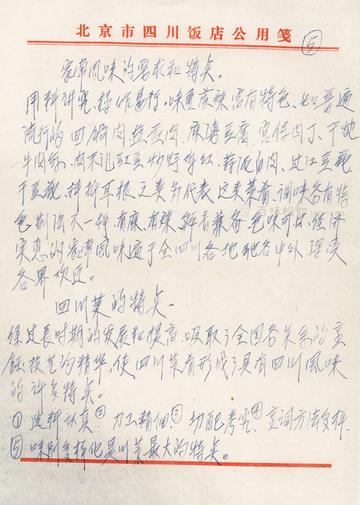
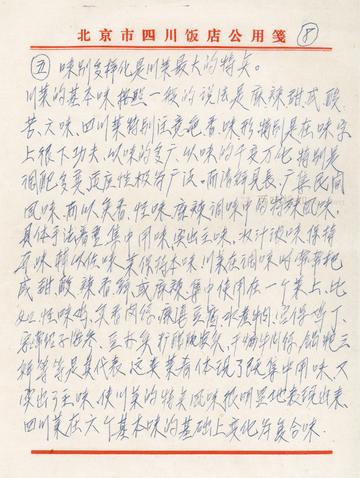
Starting midway through page ⑤, the manuscript reaches its theoretical core: “The Characteristics of Sichuan Cuisine.” He lists five overarching principles, one after another —
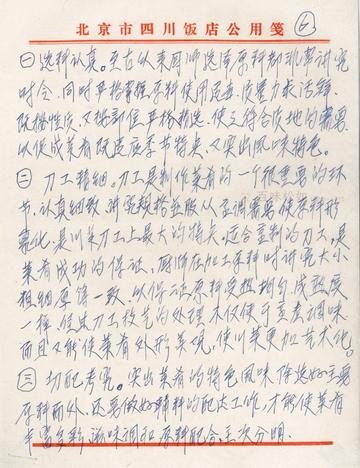
- (1) Careful ingredient selection: attention to seasonality, use of live and fresh ingredients, careful selection by the nature and part of each ingredient
- (2) Precise knife work: “subordinated to the needs of cooking, shaping the ingredient”; “uniform in size, thickness, and cut, to ensure even cooking”; “makes Sichuan cuisine more artful”
- (3) Careful matching of ingredients: clear distinction between primary and secondary ingredients, balancing nutritional value and visual appeal
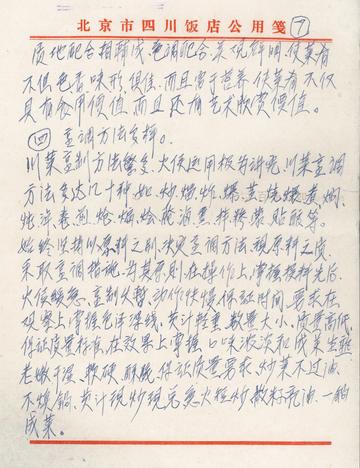
- (4) Varied cooking methods: stir-frying, pan-frying, deep-frying, flash-frying, steaming, braising, simmering, boiling, stewing, poaching, blanching, rolling, pan-searing, flash-scalding, quick-frying, and tossing — dozens of techniques, governed by a three-tier set of operational requirements: the sequence of adding ingredients and the tempo of the heat; watching color, gloss, and sauce; final judgment of texture — raw, cooked, tender, tough, wet, dry, soft, hard, crisp
- (5) Diversity of flavor: “the single greatest characteristic of Sichuan cuisine” — working relentlessly on flavor itself
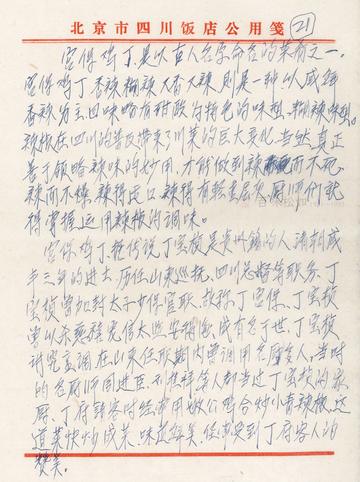
These twenty-four characters are one of the most widely circulated mnemonic formulas for Sichuan quick-frying technique; the heat-control principle described on this site’s Craft & Dishes → page has its physical source right here, on this page of letterhead. Page ⑧ closes on “working relentlessly on flavor” — “concentrate the flavor, bring out the dominant taste, reduce the sauce to intensify it, preserve the ingredient’s original flavor, and support it with secondary seasonings” — setting up the flavor-profile system explored in the next chapter.
Twenty-Three Flavor Profiles & the Philosophy of Heat
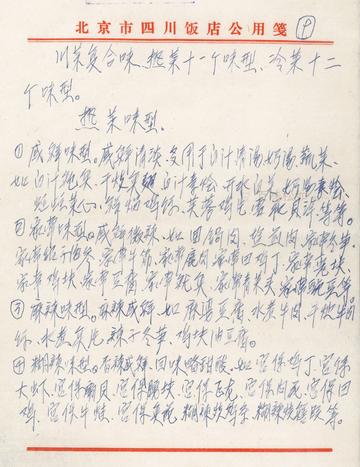
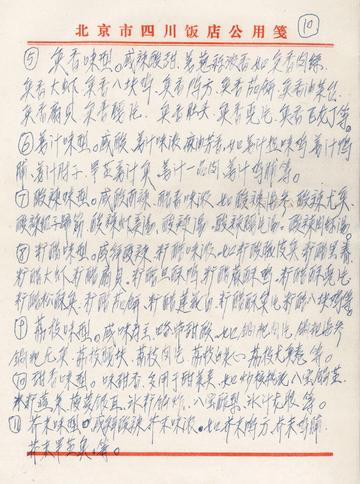
If only one page of the whole manuscript could be kept, it should be this one. The “flavor matrix” standardization concept discussed on this site’s Wisdom → page has its physical origin in exactly this line. Each flavor profile is followed by its representative dishes — a flavor profile is not an abstract category, but a map you could order from.
- 1. Salty-fresh: light and savory — supreme-broth cabbage, hibiscus chicken slices, snowflake scallop, etc.
- 2. Home-style: savory with light heat — twice-cooked pork, salt-fried pork, home-style minced-pork sea cucumber, etc.
- 3. Numbing-hot: numbing, spicy, savory — mapo tofu, water-boiled beef, dry-fried shredded beef, etc.
- 4. Sizzled-chili: fragrant and spicy, savory, with a faint sweet-sour finish — kung pao chicken, kung pao prawns, kung pao bullfrog, etc.
- 5. Fish-fragrant: sweet, sour, and spicy all at once — fish-fragrant shredded pork, fish-fragrant prawns, fish-fragrant chicken pieces, etc.
- 6. Ginger-vinegar
- 7. Sour-hot
- 8. Rice-vinegar
- 9. Lychee: — sizzling rice with pork slices, sizzling rice with sea cucumber, etc.
- 10. Sweet-fragrant: — stir-fried walnut paste, eight-treasure steamed pudding, etc.
- 11. Mustard
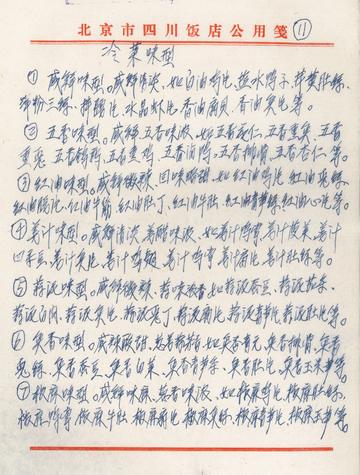
- 1. Salty-fresh: light and savory — white-oil chicken slices, salt-water duck, crystal shrimp slices, etc.
- 2. Five-spice: savory, with a strong five-spice aroma — five-spice peanuts, five-spice smoked fish, five-spice almonds, etc.
- 3. Red-oil: savory with light heat, faint sweet finish — red-oil chicken slices, red-oil tripe strips, red-oil heart slices, etc.
- 4. Ginger-vinegar: light and savory, strong ginger-vinegar aroma — ginger-vinegar duck feet, ginger-vinegar spinach, ginger-vinegar tripe strips, etc.
- 5. Garlic: savory with light heat, strong garlic aroma — garlic white-cut pork, garlic eggplant strips, garlic tripe slices, etc.
- 6. Fish-fragrant: salty, spicy, sour, sweet, with scallion-ginger-garlic aroma — fish-fragrant ribs, fish-fragrant cabbage, fish-fragrant baby corn, etc.
- 7. Pepper-numbing: savory with a numbing sensation, strong scallion aroma — pepper-numbing chicken slices, pepper-numbing duck feet, pepper-numbing tripe, etc.
- 8. Mustard: savory and sour-hot, strong mustard flavor — mustard duck feet, mustard three-shred salad, mustard scallops, etc.
- 9. Strange-flavor: every flavor at once, a lasting numbing heat — strange-flavor shredded chicken, strange-flavor rabbit cubes, strange-flavor tripe, etc.
- 10. Rice-vinegar: strong sour-hot flavor — rice-vinegar cucumber, rice-vinegar ribs, rice-vinegar cabbage roll, etc.
- 11. Numbing-hot: savory and numbing-hot, aromatic — numbing-hot shredded beef, numbing-hot beef tendon, numbing-hot ribs, etc.
- 12. Sour-hot: savory and sour-hot, sourness dominant over heat — mixed celtuce strips, mixed cabbage heart, mixed spinach, etc.
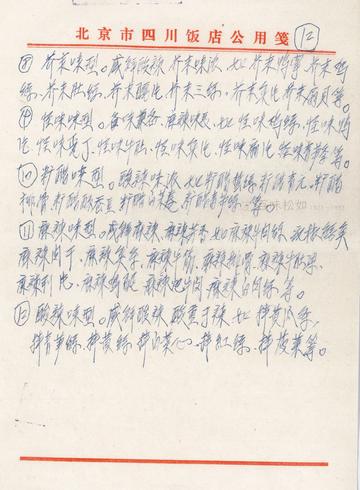
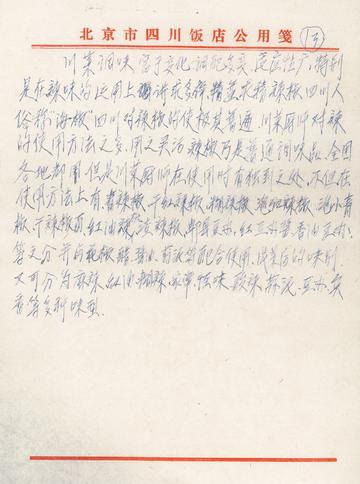
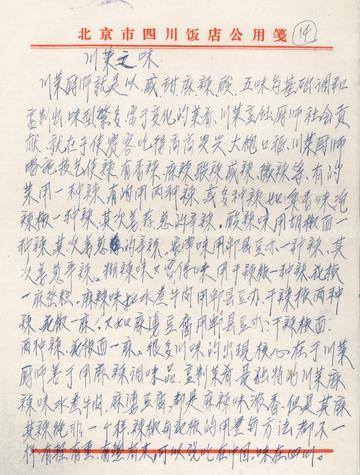
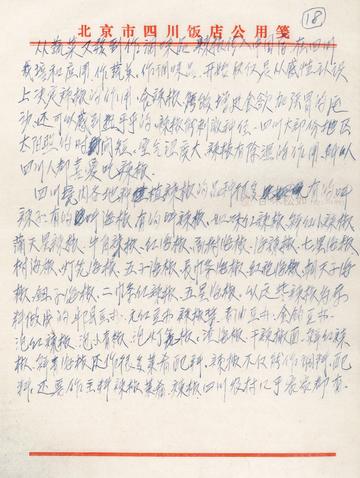
Pages ⑬ and ⑭ form a short essay on “the philosophy of heat”: fresh chilis, dried red chilis, sizzled chilis, pickled red chilis, Pixian bean paste... the same crop, split by Sichuan cooks into entirely different flavor roles. Fish-fragrant dishes use the heat of pickled chili; home-style dishes use the heat of bean paste; sizzled-chili dishes use the smoky heat of dry chili flash-seared in oil; water-boiled beef uses two different kinds of heat in a single dish; mapo tofu uses two kinds of heat plus a further layer of numbing —
The Flavor Matrix: Turning “Feel” into Something Repeatable
To address the problem of master-to-apprentice oral transmission producing inconsistent results — the same dish tasting different from one chef to the next — Chen Songru proposed a “flavor matrix” theory: breaking Sichuan cuisine’s twenty-four flavor profiles down into ratios of base components such as salt, sugar, vinegar, and chili, making seasoning quantifiable and repeatable, and leading the drafting of a “Standardization Handbook for Sichuan Cuisine.” Biographical account2 This chapter of the manuscript is precisely the original draft of that theory — eleven hot-dish and twelve cold-dish profiles, twenty-three in total (later publications and the biography round this up to twenty-four; the two figures differ, and both are presented here as they stand).
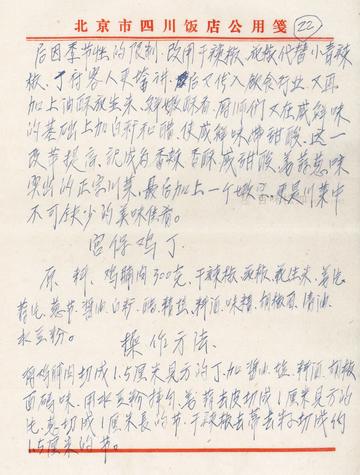
Mapo Tofu · Standardized Recipe Example
A precise recipe means different chefs, on different shifts, can produce a stable, consistent flavor — a direct expression of the decision heuristic “new tools and techniques should serve quality control, not laziness or cutting corners.”
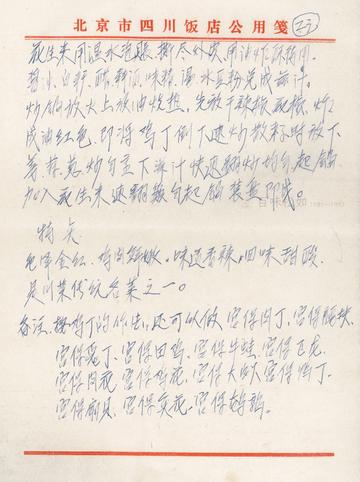
Kung Pao Chicken · Standardized Cooking Time
Timers, meat-slicing machines, and other mechanical aids were introduced to standardize the key steps of heat control and knife work.
The “Umami Trio”
Stock · soy sauce · fish sauce — used to build a stable, transferable umami base across different dishes. Biographical account
The Histories of the Famous Dishes
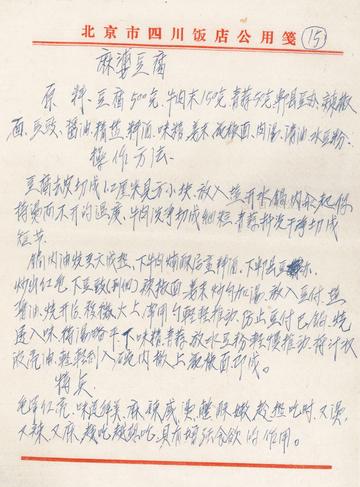
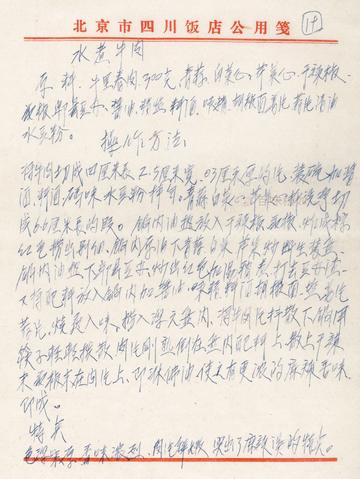
In the remaining twenty-three pages, theory gives way to specific dishes: recipes precise to the gram, histories tied to real names. Page ⑮ gives the ingredients and method for mapo tofu (500g tofu, 150g minced beef, 50g green garlic... “vivid red color... the more you eat, the more you want”); page ⑯ moves straight into its history — in 1862, by Wanfu Bridge, the wife of Chen Chunfu made tofu for the oil-cart porters; a bamboo-branch folk verse “Mapo Chen’s name still lives on”; a record in Li Jieren’s novel “The Great Wave”; “three generations and still going strong” — and he closes with a line of his own: “never underestimate the women of the kitchen.” From here the famous dishes run one after another to the end of the volume — water-boiled beef, kung pao chicken, home-style minced-pork sea cucumber, fish-fragrant shredded pork, strange-flavor shredded chicken, sizzling rice with pork slices, husband-and-wife lung slices, red-oil boiled dumplings, dan dan noodles — one dish, one story each; the final page, ㊲, closes the volume with “Sichuan Tangyuan”: Lai Yuanxin, who once sold tangyuan from a carrying pole, opened the Lai’s Tangyuan shop on Zongfu Street in Chengdu in the 1930s — the whole manuscript ends on a bowl of sweet rice-ball soup.
Honest Boundaries
The histories of the famous dishes recorded in the manuscript (such as the 1862 Wanfu Bridge account of mapo tofu’s origin, or the story behind Lai’s tangyuan) are as Chen Songru recorded them, based on the industry lore and written sources current in his time; some dates and details have since been revised by later research into the history of Sichuan cuisine. This site presents the manuscript’s original text faithfully, without silently correcting it; readers may cross-reference the News → page and other public research.
A recipe precise to the gram, and a history traced to the Chen family of 1862 Wanfu Bridge — “never underestimate the women of the kitchen.”
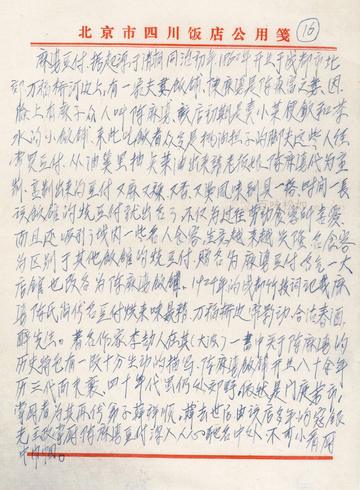
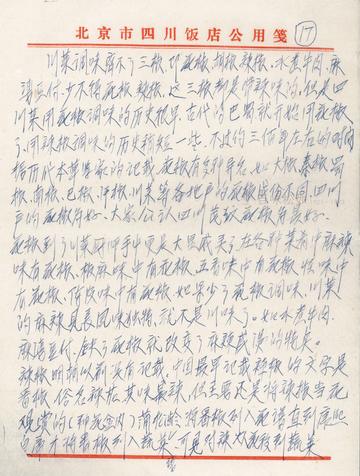
An interlude between dishes: how chili arrived in Sichuan, the varietal lineage from “manytianxing” to “erjingtiao,” and the claim that “chili can serve not only as a seasoning, but also as a main ingredient.”
During the Northern Song’s Qingli era, Zigong salt workers used salt and Sichuan pepper to water-boil beef as a quick meal — a famous dish that walked from the edge of a salt well onto the banquet table.
One of the dishes named after a historical figure: the story of Ding Baozhen and his household chef, the subtlety of heat within the sizzled-chili flavor profile, and an entire family of derivative dishes — kung pao pork cubes, kung pao prawns, and more.
Stir-fry time standardized to 2 min 30 sec; both the lychee and the salty-savory schools are taught.
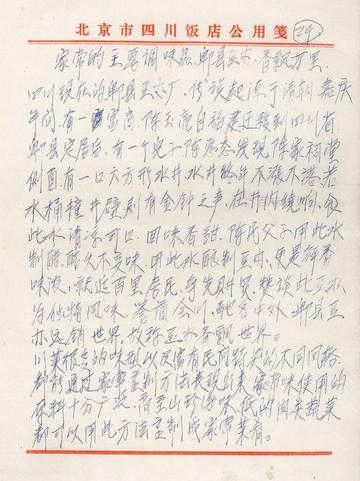
View recipe →The legend of Pixian bean paste “whose fragrance travels ten thousand li” (the story of the Chen family well), and the home-style flavor’s guiding principle: “mountain delicacies, seafood, chicken, duck, meat, and vegetables can all be turned into home-style dishes.”
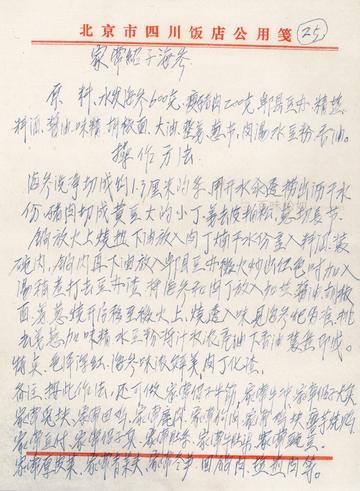
His most celebrated signature dish: a complete recipe opening with 600g reconstituted sea cucumber and 200g lean pork, with a note listing dozens of other dishes in the home-style family.
Praised by Zhu De; Choe Yong-gon’s visit led to a North Korean study delegation.
View recipe →A flavor profile “combining salty, sweet, sour, spicy, and aromatic notes” and unique to Sichuan: the recipe for fish-fragrant shredded pork, a fish-fragrant family of dishes numbered up to 39, and several accounts of where the “fish-fragrant” flavor came from, plus the method for pickled chili.
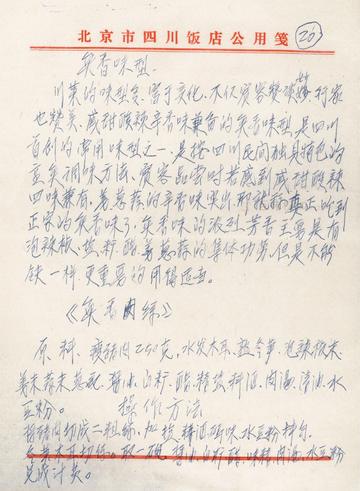
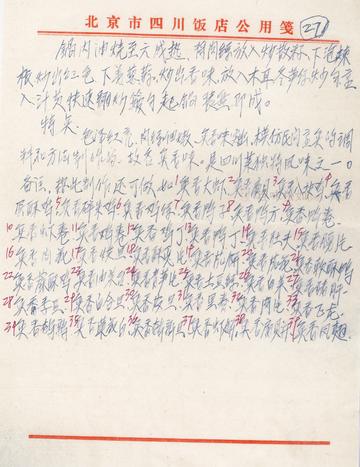
A 1982 state-banquet hot dish; pickled chili is its soul — a recipe in the same flavor family.
View recipe →“The genius of the strange flavor lies precisely in its strangeness” — a unique profile that combines salty, sweet, numbing-hot, savory, aromatic, and sour all at once, traced from folk street vendors carrying baskets of rabbit pieces to the recipe for strange-flavor shredded chicken.
A cold-dish component of the 1982 Sihanouk state banquet; the manuscript’s own formal recipe.
View recipe →A representative “dish that sings”: the sharp sizzle when hot sauce is poured over scalding rice-crust. He records both the resourcefulness of a chef who turned kitchen scraps into a famous dish, and an anecdote about the American food critic Mimi Sheraton making a special trip from Philadelphia in 1980 to eat it.
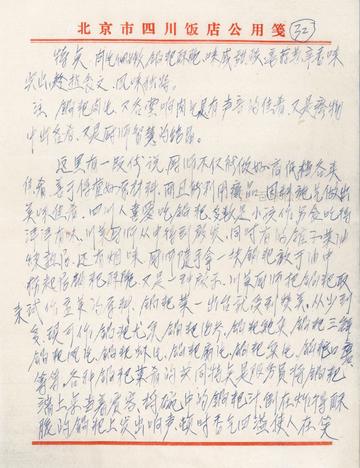
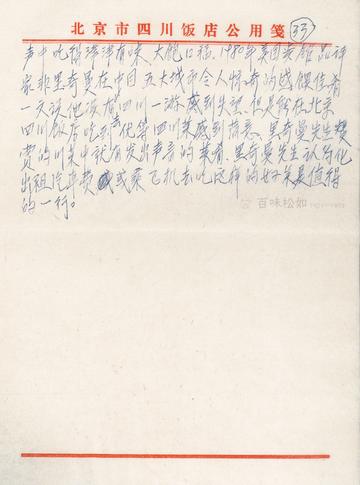
Rice-crust hits the plate with a sharp crackle — a signature texture unique to Sichuan cuisine.
View recipe →The story of how Mr. and Mrs. Guo Zhaohua got their start selling lung slices from a street stall in Chengdu, and the method of braising beef and offal separately before dressing them in red-oil chili.
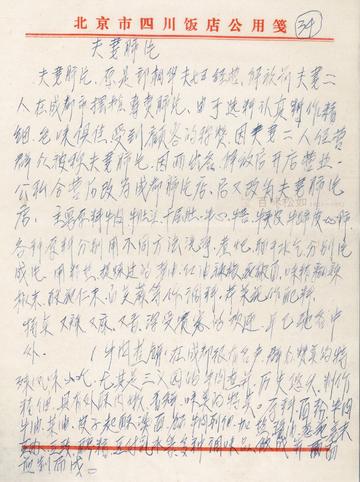
Zhong’s Dumplings, a household name across Sichuan: seasoned with sugar, soy sauce, and red-oil chili — “thin skin, tender filling, spicy with a faint sweet aftertaste.”
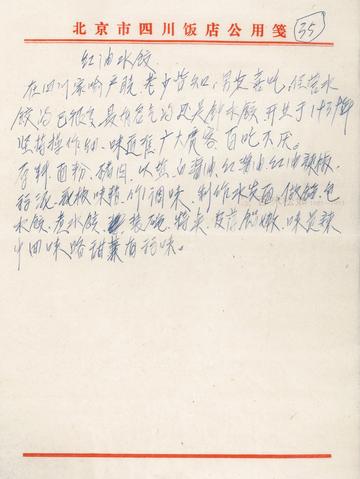
A dish sold from a carrying pole: one end held a stove for boiling noodles, the other held condiments, bowls, and chopsticks. From Chen Baobao’s carrying pole in Zigong to a Sichuan-flavor calling card that Japanese guests would ask for by name.
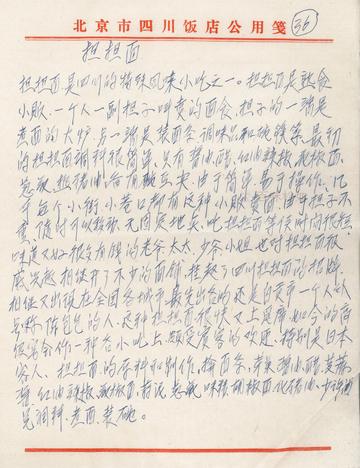
The entire manuscript closes on a bowl of sweet tangyuan: Lai Yuanxin, who once sold rice balls from a carrying pole, opened the Lai’s Tangyuan shop on Zongfu Street in Chengdu in the 1930s.
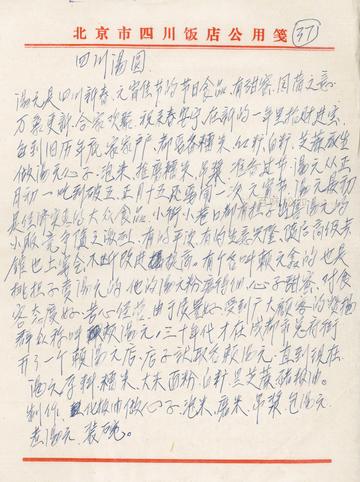
Drafts & Lecture Notes: The Handwriting Before the Final Version
◈ A Bound Volume of Drafts, Kept Alongside
Preserved together with the fair copy is a bound notebook of drafts and lecture notes, its cover reading “The History and Characteristics of Sichuan Cuisine” (Sichuan Restaurant notepaper, with rust marks left by a paper clip). One page of lecture notes is signed and dated “Lectured 10.28.80”, with red-pen annotations in his own hand — this treatise was actually used to teach around 1980; the theory wasn’t written and filed away, it was carried into the classroom. There is also a red-pen revision draft of “Sichuan Tangyuan,” which can be compared directly against page ㊲ of the fair copy to see exactly which characters he changed.
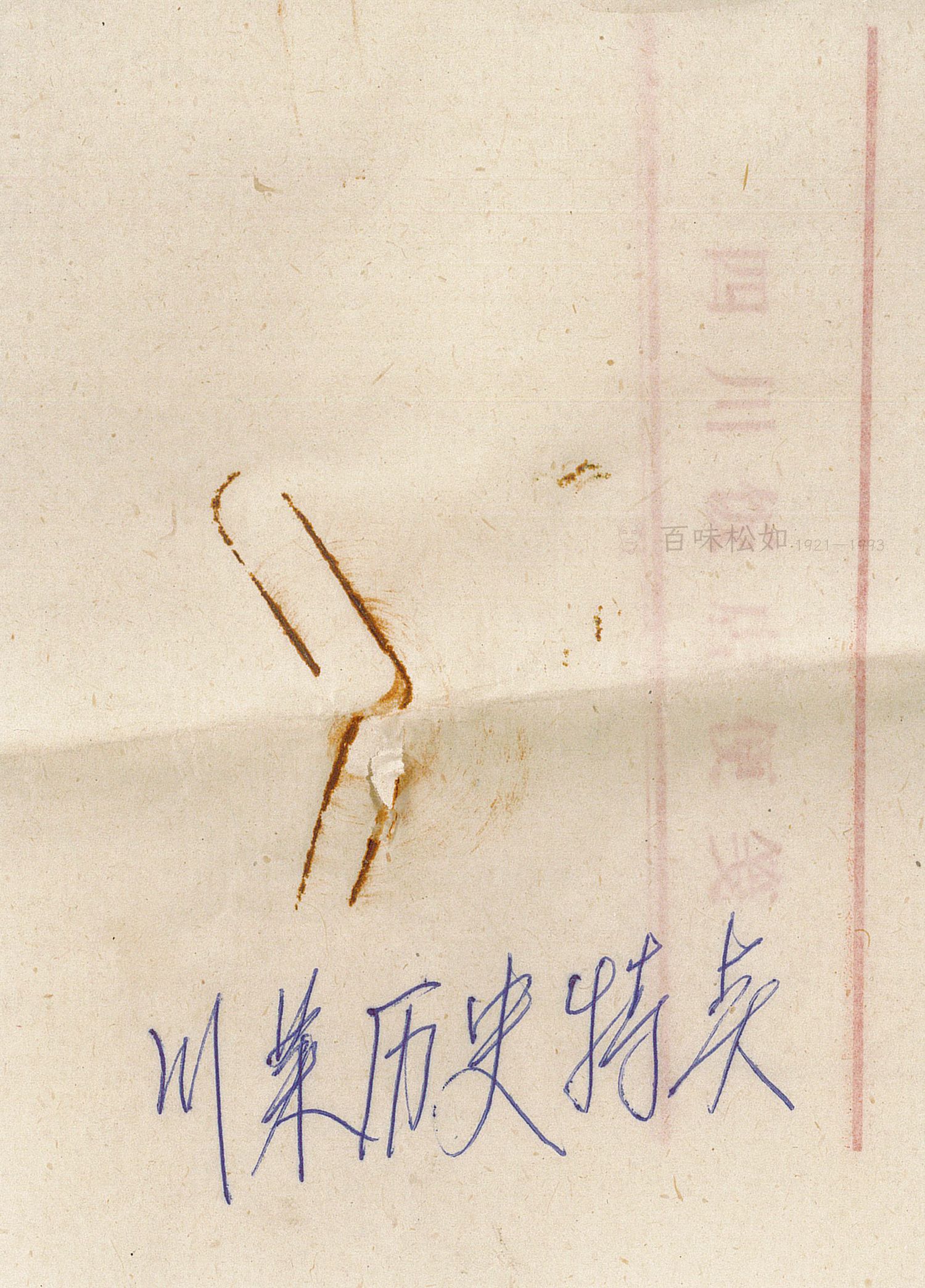
Honest Boundaries
The fair copy carries no date of composition anywhere in the manuscript. Based on the “Lectured 10.28.80” signature in the bound notebook, it can be inferred that this treatise was written and put to use around 1980. In addition, the fair copy itself records an anecdote from 1980 (an American critic from Philadelphia making a special trip to eat the crackling-rice dish), which sets a lower bound for when it was written and corroborates that signature. But the exact dates of first drafting and of the fair copy remain uncertain, and this site does not assert a specific date.
Where These Words Went Next
The flavor-profile system, mnemonic formulas, and dish histories in the manuscript later found their way into two books he published in his later years. What directly drove him to pick up the pen was his deep concern that “some Sichuan dishes were losing their authenticity in the course of being passed down” — that so-called “Sichuan dishes” were having their cooking methods and seasoning ratios altered at will to suit local tastes, losing their original character.First-hand account3
“Recipes of the Sichuan Restaurant” 📖
Published in January 1989 by Sichuan Science and Technology Press. Focused mainly on banquet dishes for the four seasons, it records ingredient ratios, preparation steps, and cost calculations in detail, serving both as a technical guide and a reference for restaurant management — known as the Sichuan Restaurant’s “book of secret techniques.” Only around 9,000 copies were printed in the first edition; aside from 50 copies the author kept for himself, all were given to banquet guests by the restaurant and never sold to the public. Surviving copies are now rare.Independent source4
Cover →Copyright page →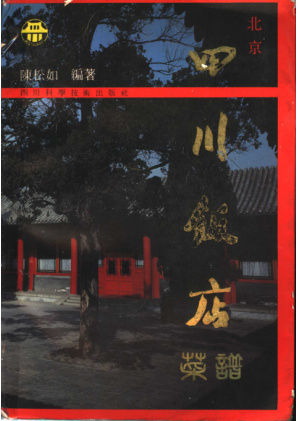
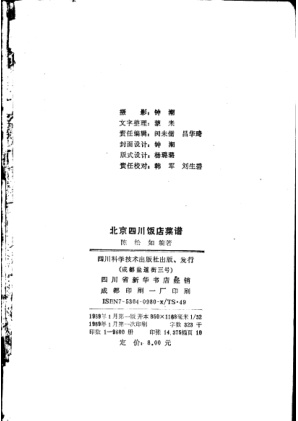
Written permission has not yet been obtained from the publisher and the family for public digital distribution of the full scanned book; only the cover and copyright page are shown here, and the full text is not currently available to read online.
“160 Authentic Sichuan Dishes” 📖
Published in December 1991 by Jindun Press (some editions’ covers read “160 Examples” — an internal inconsistency in the book itself, recorded here as it stands). Aimed at popular dishes at an accessible price, it went through 17 consecutive reprints. Its 160 dishes are divided into seven categories — cold dishes, pork and beef, poultry, seafood, mountain delicacies, vegetarian dishes, and snacks — with color photographs of the finished dishes, aimed at home cooks, cooking enthusiasts, professional chefs, and culinary schools alike.
Cover →Copyright page →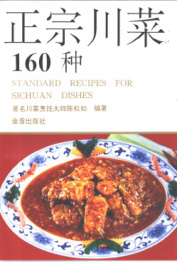
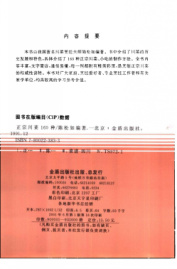
Written permission has not yet been obtained from the publisher and the family for public digital distribution of the full scanned book; only the cover and copyright page are shown here, and the full text is not currently available to read online.
For Researchers: A Structured Citation Manifest (IIIF)
The 41 scans on this page (cover + 37 pages of text + 3 supplementary drafts: a lecture outline, a tangyuan-recipe draft, and its own cover sheet) have been compiled into a static manifest conforming to the IIIF Presentation API 3.0 standard, including per-page dimensions, captions, and stable links. It can be read directly by IIIF-compatible tools such as Mirador and Universal Viewer, and can also serve as a structured data source for academic citation:
assets/manuscripts/chuancai37/manifest.json
Honest disclosure: this site is hosted as pure static content with no server-side image processing, so this manifest does not include an IIIF Image API dynamic tiling/zoom service — its image resources point directly to the static originals. The close-reading zoom experience on this page (drag, scroll-wheel zoom, double-click to zoom) is provided separately by the embedded OpenSeadragon (an open-source viewer) — click any manuscript image to use it. The two are complementary, not the same system.
Object-Level Rights Statement
- Physical ownership: The family (originals lent for scanning by Mr Chen Tinglong)
- Digitization & metadata: This site (Baiwei Songru digital archive), a non-profit personal project
- Standardized rights statement: In Copyright (rightsstatements.org InC/1.0)
- Permitted use: Images here may be viewed and cited for remembrance and research. Republication, publication, or any commercial use requires written permission from the family; this site neither exercises nor sublicenses that right.
The Taste on the Page
Once the 37 pages were finished, he went back to the stove. The twenty-three flavor profiles on the page, the five defining traits, the mnemonic formulas — they later found their way into two published books, “Recipes of the Sichuan Restaurant” and “160 Authentic Sichuan Dishes,” and into the hands of his apprentices. To see what these words became on a plate, follow these threads onward.
Sources
- Primary objectSee the research entry “27 — Manuscript The History and Characteristics of Sichuan Cuisine, 37 pages + 1987 Singapore footage, in-depth verification”: the manuscript has been kept by the family to this day and was published in full digitally for the first time in August 2026 (high-resolution scans, 2,886 × 4,232 px). A bound volume of drafts and lecture notes kept alongside it carries the annotation “lecture, 80.10.28” with the author’s own corrections in red — the only direct evidence that this text was actually used in teaching.↩
- Biographical accountBiography Songfeng Ruren, chapter 5, section 5: Chen Songru proposed a “flavour-profile matrix”, breaking the twenty-four Sichuan flavour profiles down into ratios of salt, sugar, vinegar, chilli and other base components, and led the drafting of a Sichuan Cuisine Standardisation Handbook. The examples of a mapo tofu recipe specified to the gram and a kung pao chicken stir-fry timed at exactly 2 minutes 30 seconds both come from this section.↩
- First-hand accountThe preface to the fair copy, and the section “From manuscript to publication” in the research notes, record that Chen Songru began writing because he felt some Sichuan dishes had “lost their flavour” in transmission — cooks were altering methods and seasoning ratios to suit local tastes, and the dishes were losing what made them what they were.↩
- Independent sourceCombining Chen Tinglong’s oral account (as reported by China News Service and others) with the CIP data printed on the copyright page of The Sichuan Restaurant Cookbook: the book was published in 1989 by Sichuan Science and Technology Press in a first printing of just over 9,000 copies (the copyright page reads precisely “1–9,600”). Apart from fifty copies Chen Songru kept himself, all were given by the restaurant to banquet guests; no later printing is known and it was never sold to the public. This is a different order of magnitude from 160 Authentic Sichuan Dishes (cumulative print run over 900,000) and the two should not be conflated.↩